When a Roof Leaks, Cold Patch Repair Is Your Fastest Fix
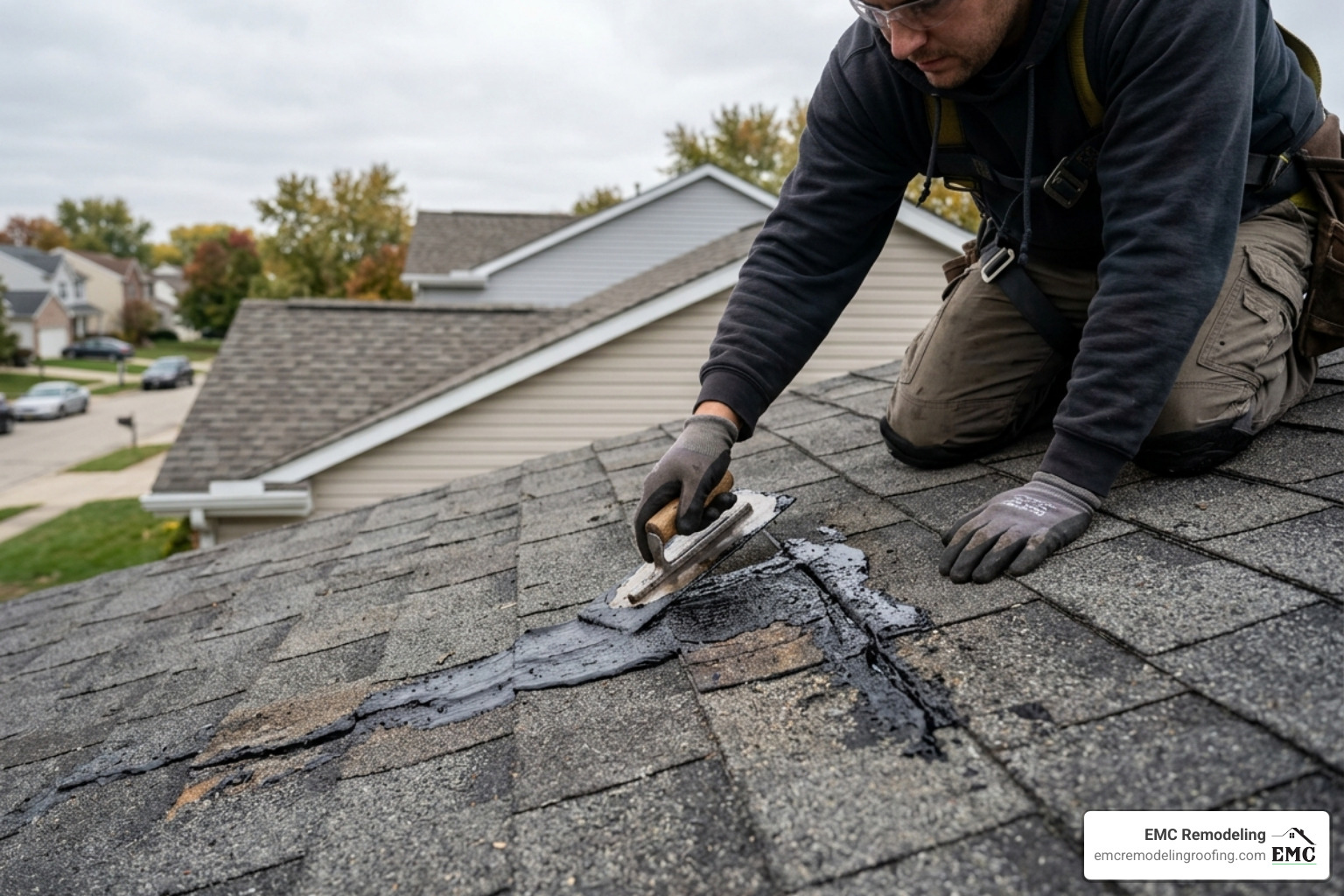
Cold patch roof repair is a method of sealing roof leaks using a ready-to-use, cold-applied sealant — no heat equipment required. You trowel or brush it directly onto cracks, holes, or failing seams, and it bonds on contact, even in rain or freezing temperatures. As a trusted local roofing contractor, we understand that a roof leak rarely waits for good weather.
Here’s what you need to know at a glance:
| Question | Quick Answer |
|---|---|
| What is it? | A cold-applied asphalt or rubber sealant for sealing roof leaks |
| When can you use it? | In temperatures as low as 0°F (some products down to 25°F), even on wet surfaces |
| How long does it last? | Up to 10 years with proper application (e.g., Henry 208R 10-year limited warranty) |
| Is it DIY-friendly? | Yes — no special tools or heat equipment needed |
| Best for? | Emergency leaks, shingles, flashing, vents, chimneys, EPDM, TPO, and metal roofs |
Whether it’s a cracked shingle after a Central Texas hailstorm or a failing flashing seam in the middle of winter, you need a fix that works now — not next week when conditions are perfect. That’s exactly where cold patch sealants shine.
Unlike traditional hot-applied roofing methods that require melting equipment and dry conditions, cold patch products come ready to use straight from the container. They’re formulated to stick to wet, cold, or aged surfaces — making them one of the most practical emergency roof repair solutions available to homeowners today.
I’m Matthew Runyon, President of EMC Remodeling & Roofing, and with over 15 years of hands-on roofing experience in Central Texas, I’ve seen cold patch roof repair save countless properties from serious water damage when time was critical. In this guide, I’ll walk you through exactly how to use these products safely and effectively.
Simple cold patch roof repair glossary:
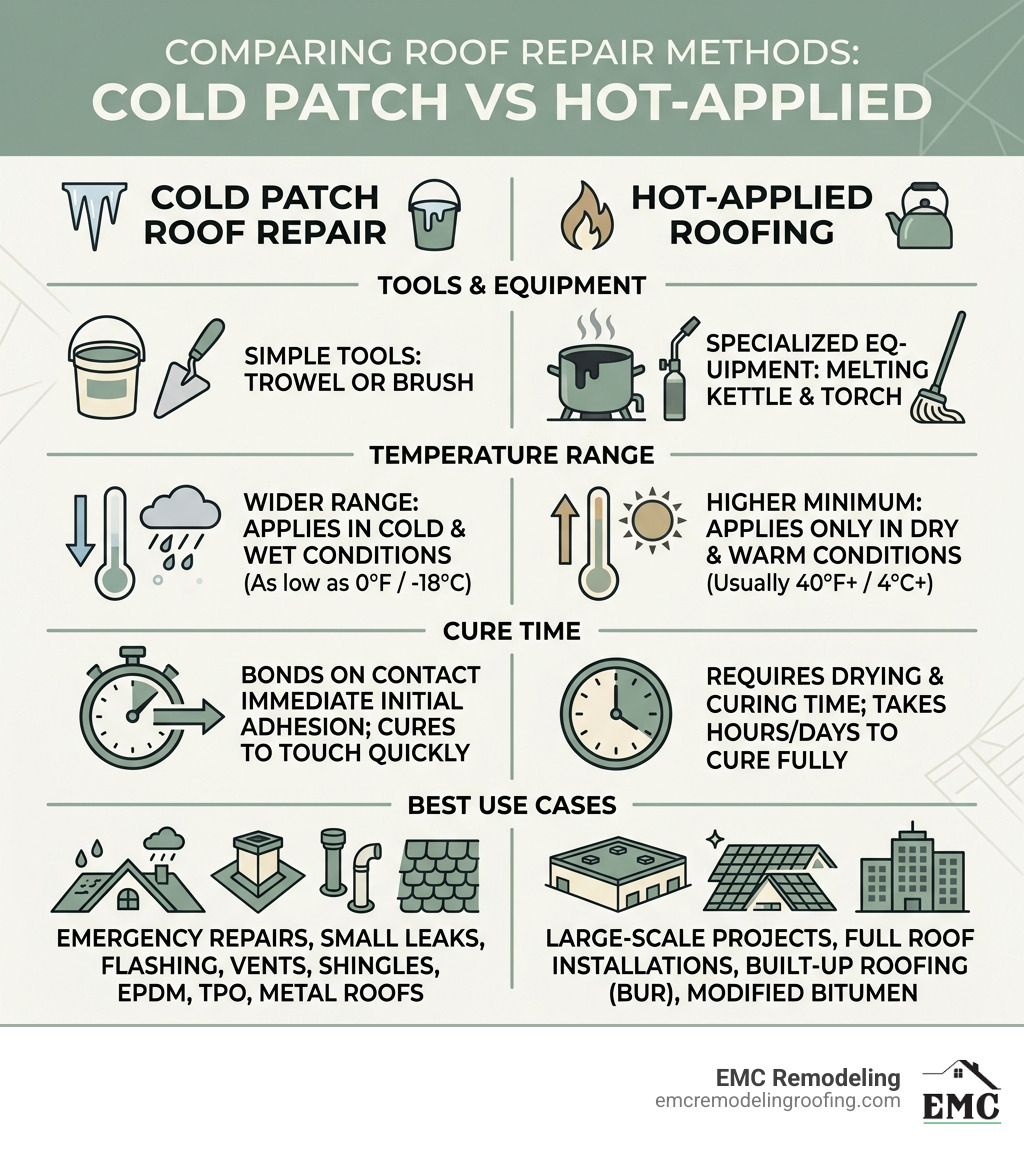
Understanding Cold Patch vs. Traditional Hot-Applied Methods
To understand why cold patch is a game-changer, you first have to look at how roofs were traditionally fixed. Traditional hot-applied methods involve melting solid blocks of asphalt in a large kettle at temperatures exceeding 400°F. This liquid asphalt is then mopped onto the roof. While effective for large commercial installations, it is dangerous, requires specialized heavy machinery, and is nearly impossible to perform during a rainstorm.
In contrast, cold patch roof repair utilizes an asphalt-based mastic or rubberized sealant that remains pliable at room temperature. These products rely on solvent evaporation rather than cooling to set and harden. Modern formulations, such as those featuring SBS rubber-modified asphalt, allow the sealant to stretch and contract with your roof as temperatures fluctuate.
For homeowners and DIY enthusiasts, the choice is clear. Cold patch sealants offer a no-heat application that eliminates the risk of burns or fires on the roof. They are designed for precision, allowing you to address specific problem areas like flashings, joints, and valleys without needing a full crew. According to technical specifications for high-grade mastics, these cold-applied options often outperform traditional cements because they contain plasticizing oils and long-strand fibers that prevent the patch from cracking or sagging over time.
Key Advantages of Cold Patch Sealants
The primary reason we recommend keeping a gallon of cold patch in your garage is its versatility. Here are the standout benefits:
- Instant Adhesion in Wet Conditions: Products like Henry 208R are specifically engineered to displace water. You can literally apply them under standing water to stop a leak instantly during a downpour.
- Extreme Temperature Range: Many cold patch sealants can be applied in temperatures ranging from 0°F to 120°F. This makes them essential for our emergency roof repair services in Central Texas, where we can face freezing winter nights and blistering summer days.
- Superior Flexibility: Because these sealants are rubberized, they don’t become brittle. They can handle an ultimate elongation of 400-500%, meaning they move with your house rather than pulling away.
- Long-Term Protection: A properly applied cold patch isn’t just a “band-aid.” Top-tier products often come with a 10-year limited warranty, providing peace of mind for a decade.
Step-by-Step Guide to Applying Cold Patch Roof Repair
Applying a cold patch is straightforward, but doing it correctly ensures the leak doesn’t return. The most common mistake is simply “globbing” the material over a hole. Instead, we recommend the professional “3-course patch” method.
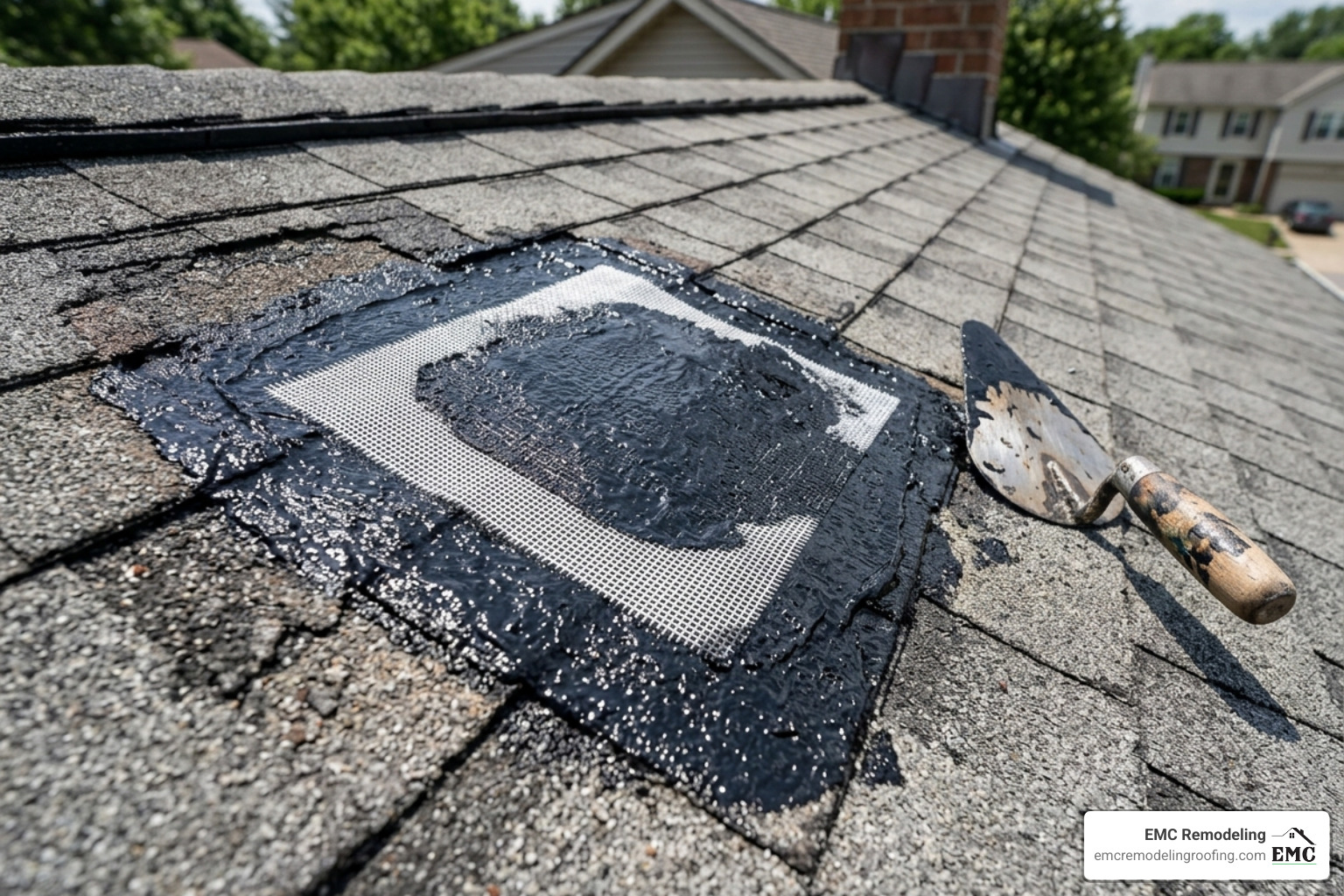
- Preparation: Clear the area of all loose debris, dirt, and old, peeling sealant. If you are dealing with a snowy roof, use a plastic shovel to clear the area first.
- Initial Layer: Using a roofing trowel or a stiff putty knife, apply a layer of cold patch sealant approximately 1/8 inch thick. Ensure the patch extends at least 2 to 3 inches beyond the edges of the leak.
- Reinforcement: Embed a piece of reinforcing fabric (like Henry 181 or 183) into the wet sealant. Press it down firmly to ensure there are no air bubbles or wrinkles.
- Top Coat: Apply a second layer of sealant over the fabric, completely covering it. This “sandwich” creates a reinforced membrane that can withstand structural movement.
For more detailed instructions on specific roof types, check out The Ultimate Guide To Patching Your Roof With Tar.
Preparing the Roof Surface for Cold Patch Application
Preparation is 90% of the job. Even though many cold patch products are “wet-rated,” the sealant will bond much better if the surface is as clean as possible.
- Clean the Area: Use a soft-bristled brush to sweep away loose granules and dust.
- Dry the Surface (If Possible): If you’re working on an EPDM or rubber roof in winter, a heat gun or even a hair dryer can be used to dry the area and warm the substrate. This helps the primer or sealant “bite” into the material.
- The Tack and Pull Test: If you are using a primer (common for EPDM repairs), wait until it is tacky. Touch it with your finger; if it sticks but doesn’t pull away strings of liquid, it’s ready.
- Remove Snow and Ice: Never apply a patch directly over ice. The ice will eventually melt, leaving a gap between your roof and the patch, which will fail immediately.
If you are working specifically with shingles, our guide on patching your asphalt roof provides more site-specific tips.
The 3-Course Method for Durable Cold Patch Roof Repair
Why do we emphasize the 3-course method? Because roofs move. Between the heat of a Texas afternoon and a cool night, your roof expands and contracts. Without the reinforcing mesh, a simple layer of tar might crack.
When you use the 3-course method, you are effectively creating a custom-fit piece of flashing. This is especially important for repairing asphalt shingles around high-stress areas like chimneys, plumbing vents, and skylights. A single gallon of sealant typically covers about 12.5 square feet at 1/8 inch thickness, which is plenty for several reinforced repairs.
Choosing the Best Cold Patch Roof Repair Products for Your Roof Type
Not all cold patch products are created equal. Choosing the wrong one can lead to a failed repair or even damage to your existing roofing material.
| Product Type | Best Substrates | Key Feature |
|---|---|---|
| Rubberized Wet Patch (e.g., Henry 208R) | Asphalt Shingles, BUR, Modified Bitumen | Works under water; 10-year warranty |
| Winter-Grade Mastic (e.g., Mightyplate) | Metal, Concrete, Gravel | Trowelable down to 25°F; no-creep formula |
| Silicone Roof Patch | TPO, EPDM, PVC, Metal | 400%+ elongation; UV and ponding water resistant |
| Eco-Friendly (Ecodur) | Almost all substrates | VOC-free; lifetime repairability; odorless |
For EPDM rubber roofs, special care is required. You often need a specific EPDM primer and a patch kit that includes a silicone roller to ensure a tight seal. You can find more on this in the Emergency Winter Rubber Roof Repair guide.
Best Cold Patch Roof Repair Solutions for Winter Leaks
Winter repairs are the most difficult because many standard sealants become as hard as a rock in the bucket when the temperature drops. If you are facing a leak in January, you need a winter-grade plastic cement like Mightyplate Winter-Patch.
These products are formulated with catalytically air-blown asphalt, which allows them to remain “trowelable” even when it’s 25°F outside. More importantly, they feature a “no-creep” formula. This means if you apply it to a vertical surface, like a chimney or a parapet wall, it won’t slide down the wall as soon as the sun hits it.
Silicone and Eco-Friendly Cold Patch Options
If you are dealing with a flat roof where water tends to “pond” (sit in puddles), a standard asphalt patch might not be enough. Asphalt is not designed to be submerged indefinitely. In these cases, a Silicone Roof Patch is superior. Silicone is naturally resistant to ponding water and offers incredible UV resistance, which is vital in the Texas sun.
For those concerned about the environment, there are newer options like Ecodur. These kits are 100% solids, VOC-free, and BPA-free. They are odorless, making them safe for use on schools or hospitals where chemical smells could be a problem. They offer up to three times the adhesion of traditional coatings and are considered “lifetime repairable,” meaning you can always add more later without having to scrape off the old layer. Learn more about these advanced materials in our Complete Roofing Repair Guide.
Common Mistakes and Maintenance for Long-Lasting Repairs
Even the best cold patch roof repair can fail if you don’t follow the rules of the material. Here are the most common pitfalls we see:
- Trapping Water: If you patch over a wet area without using a “wet-rated” product, you will trap moisture against the wood decking, leading to rot.
- Ignoring Cure Times: Most asphalt-based patches need 30 days to “off-gas” solvents before you can apply a reflective topcoat (like aluminum coating). If you coat it too early, the patch will blister.
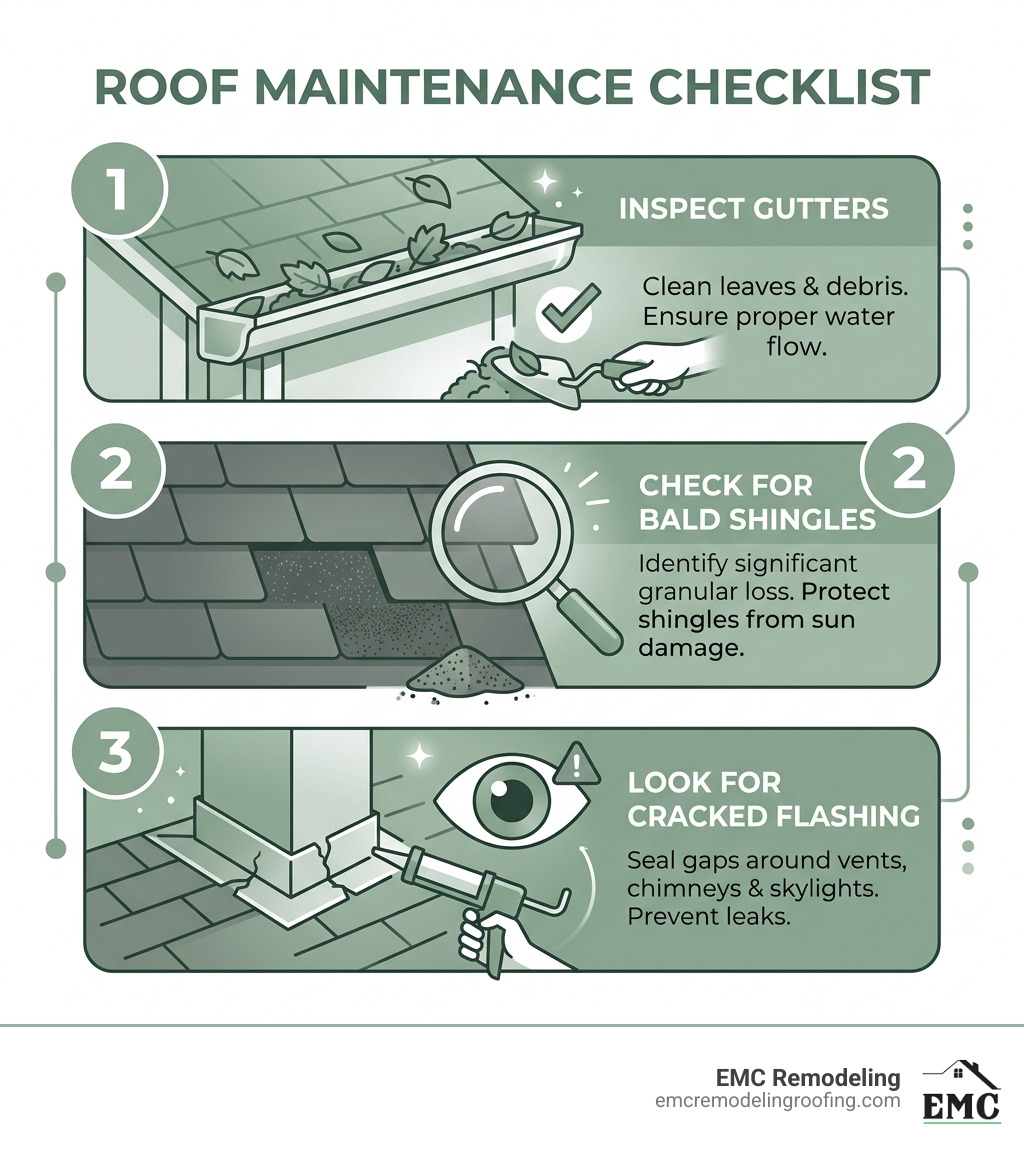
- Missing Granular Loss: If you’re patching shingles, check the surrounding area for granular loss. If the shingles are “bald,” the patch might stop the leak, but the rest of the roof is likely at the end of its life. Check our Asphalt Roof Repair Guide 2025 for signs of shingle failure.
- Skipping Safety Gear: Roofing mastics are incredibly sticky and hard to get off your skin. Always wear heavy-duty gloves and old clothes.
Frequently Asked Questions about Cold Patch Roof Repair
Can cold patch be applied to a wet or snowy roof?
Yes, provided you use a product labeled as “Wet Patch” or “All-Weather.” These products contain surfactants that displace water, allowing the asphalt to bond directly to the substrate even under standing water. For snowy roofs, you must remove the snow and any ice before applying the sealant.
How long do cold patch repairs typically last?
A high-quality, reinforced cold patch (using the 3-course method) can last between 5 to 10 years. However, cold patches are often considered “temporary-permanent” fixes. While the patch itself may hold, the fact that a leak occurred often suggests that the surrounding roofing material is aging and may need a professional inspection.
Is cold patch repair as effective as professional services?
For small, localized leaks, a DIY cold patch is highly effective and cost-efficient. However, it cannot replace the structural integrity of a professional repair. A professional roofer will often replace the underlying damaged wood or flashing rather than just sealing over it. If your leak is large or you have multiple leaks, it’s time to call in the experts.
Conclusion
At EMC Remodeling, we know that a leaky roof is a major stressor for any homeowner in Temple, TX, or Leander, TX. While cold patch roof repair is a fantastic tool for instant, DIY leak protection, some jobs require a professional touch to ensure your home stays dry for the long haul.
We are a family-operated business that prides itself on exceptional craftsmanship and 24/7 emergency support. Whether you need a quick patch or a full roof replacement, we’re here to help with direct owner involvement on every project.

Don’t let a small leak turn into a massive repair bill. If you’ve applied a patch and want a professional to verify the health of your roof, or if the job is just too big to handle on your own, reach out to us.
Need a professional eye on your roof? Explore our Roof Repair Services today for a free inspection.
