Why Finding the Right Hot Tar Roofers Matters for Your Commercial Building
Hot tar roofers are specialists in Built-Up Roofing (BUR) — one of the most durable and time-tested commercial roofing systems available. If you need a quick answer, here’s what to know:
How to find a qualified hot tar roofing contractor:
- Look for licensed, bonded, and insured contractors with documented BUR experience
- Ask about their kettle safety certifications and temperature control protocols
- Confirm they follow ASTM D312 standards for roofing-grade asphalt
- Choose a local contractor who knows your regional climate and building codes
- Request a free roof inspection before committing to any scope of work
For trusted commercial roofing services in Central Texas, EMC Remodeling brings the hands-on expertise your building deserves.
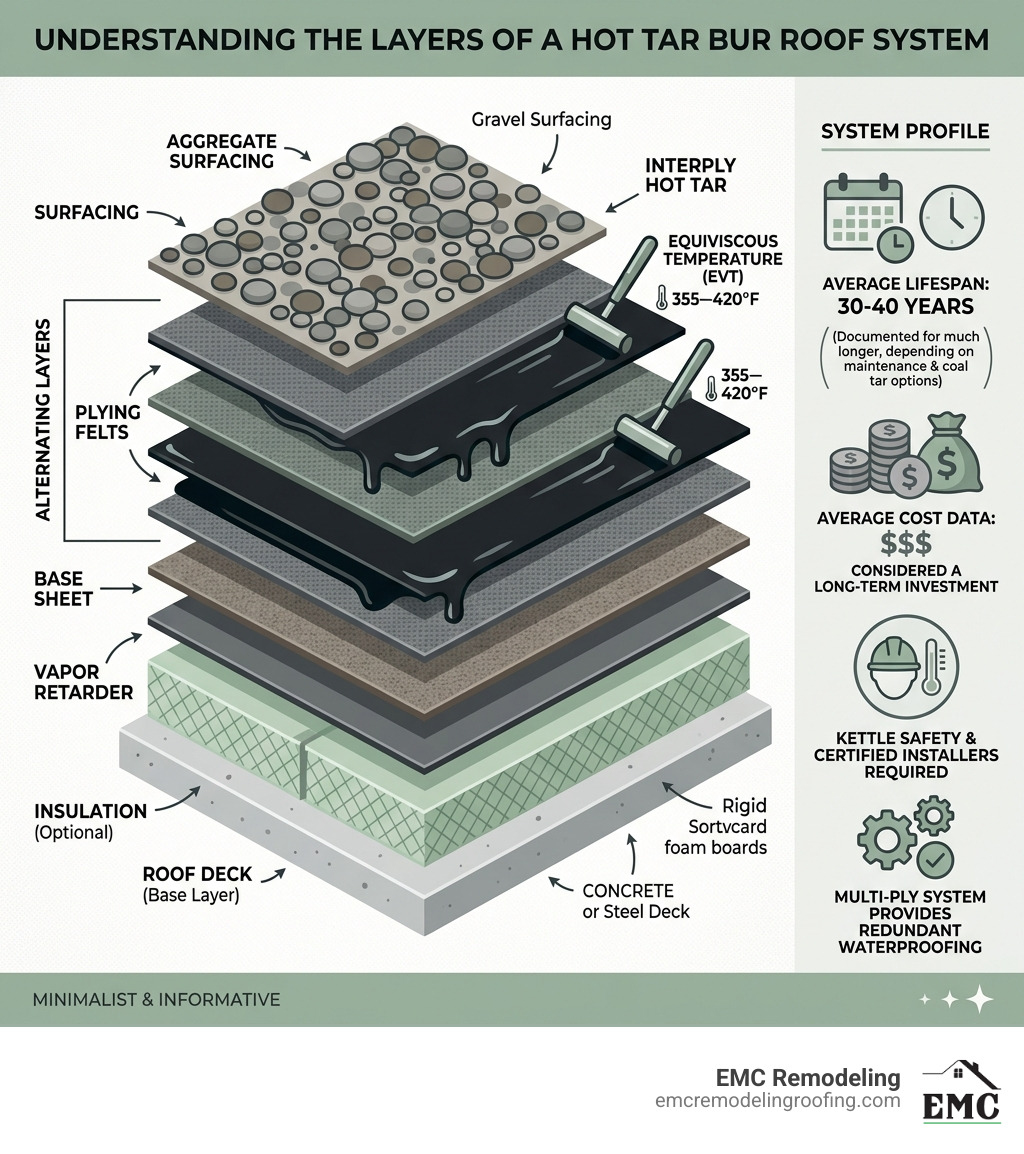
Hot tar roofing has been protecting commercial buildings for well over a century. A properly installed BUR system uses three to five layers of asphalt-saturated felt, each fully bonded with hot asphalt, to create a waterproofing membrane with built-in redundancy. That multi-ply structure is why these roofs can stay watertight for 30 to 40 years — and why coal tar versions have been documented lasting 60 years or more.
But the system only performs as well as the contractor who installs it. Hot asphalt must be applied within a precise temperature window — the Equiviscous Temperature (EVT) of 355–420°F — to bond correctly. Too cold and it won’t adhere. Too hot and you risk dangerous fumes and a compromised membrane. That kind of precision requires real experience, not a generalist with a kettle.
I’m Matthew Runyon, President of EMC Remodeling, and with over 15 years in the roofing industry I’ve seen what separates a long-lasting hot tar roof from one that fails early — and it almost always comes down to the quality of the hot tar roofers doing the work. In this guide, I’ll walk you through everything you need to know to find the right contractor for your building.
Terms related to hot tar roofers:
The Science Behind Built-Up Roofing (BUR): How Hot Tar Systems Deliver Superior Protection
At its core, a hot tar roof is a scientifically engineered sandwich of protection. It isn’t just “pouring tar on a roof”; it is a sophisticated layering process that creates a monolithic, waterproof shield. Professional hot tar roofers use bitumen layers (either asphalt or coal tar pitch) interspersed with reinforcing fabrics like asphalt-saturated felt or fiberglass mats.
The quality of the material is governed by strict ASTM D312 standards. During the manufacturing process, raw asphalt is heated to approximately 500°F and injected with air—a process known as “air blowing.” This adjusts the hardness and viscosity, ensuring the material remains stable under the scorching Texas sun.
For the installation to succeed, the asphalt must reach its Equiviscous Temperature (EVT). This is the “sweet spot” (typically between 355°F and 420°F) where the asphalt has the perfect viscosity to flow into the felt layers and create a permanent bond. If you’re managing a property in Temple or Leander, ensuring your contractor understands these thermal dynamics is the difference between a 30-year roof and a 5-year headache. For more insights into maintaining your roof, check out our more info about flat roof repair guide.
Identifying Your Roof Type: Asphalt vs. Coal Tar
Not all “tar” roofs are created equal. If you are looking at an older building, it might have a coal tar pitch roof rather than modern asphalt. Here is how professional hot tar roofers identify what they are working with:
- The Smell Test: Coal tar has a very distinct, pungent, creosote-like odor. Asphalt smells more like oily road work.
- The Mineral Spirits Test: This is the gold standard field test. Place a small sample of the roof bitumen in a jar with mineral spirits. Coal tar will turn the liquid a reddish-brown or amber color. Asphalt will turn it dark brown or black.
- Pliability Check: Aged coal tar is notoriously brittle and will crack easily if bent. It often develops “alligatoring” cracks—a pattern that looks like reptile skin—due to the loss of volatile oils over decades.
- Self-Healing Properties: Coal tar has a lower softening point. On a hot day, it can actually “flow” to seal small hairline cracks, a property asphalt lacks.
Unmatched Durability: Why Professional Hot Tar Roofing Excels for Commercial Buildings

The primary reason property owners still seek out hot tar roofers in an era of “modern” plastics is redundancy. A single-ply roof (like TPO) relies on one thin membrane. If a tool drops or a hailstone hits just right, the system is breached. In contrast, a 4-ply BUR system has four separate layers of waterproofing. Water would have to find a hole in all four layers, perfectly aligned, to enter your building.
This redundancy allows BUR systems to stay watertight for 30 to 40 years. Furthermore, hot tar roofs are exceptionally resistant to UV radiation and mechanical stress. When surfaced with a gravel flood coat, the roof becomes nearly impervious to foot traffic and wind uplift. If you are worried about storm season, it is worth spotting hail damage on your flat roof early to see if a BUR system could provide the extra armor your building needs.
Cost-Effectiveness and Annual Service Value
While the initial cost of a hot tar roof can be higher than some single-ply alternatives due to labor intensity, the “cost per year of service” is where it shines.
Consider this: A high-quality coal tar BUR system installed in the mid-20th century had an initial cost equivalent to roughly $2.10 per square foot in today’s dollars. With a 40-year lifespan, that equates to a measly $0.0525 per square foot per year. Modern alternatives often cost ten times that amount when you factor in their shorter lifespans and higher replacement frequencies. For robust protection that makes sense for your bottom line, explore EMC Remodeling’s commercial roofing services.
Precision and Expertise: The Hot Tar Roofing Installation Process
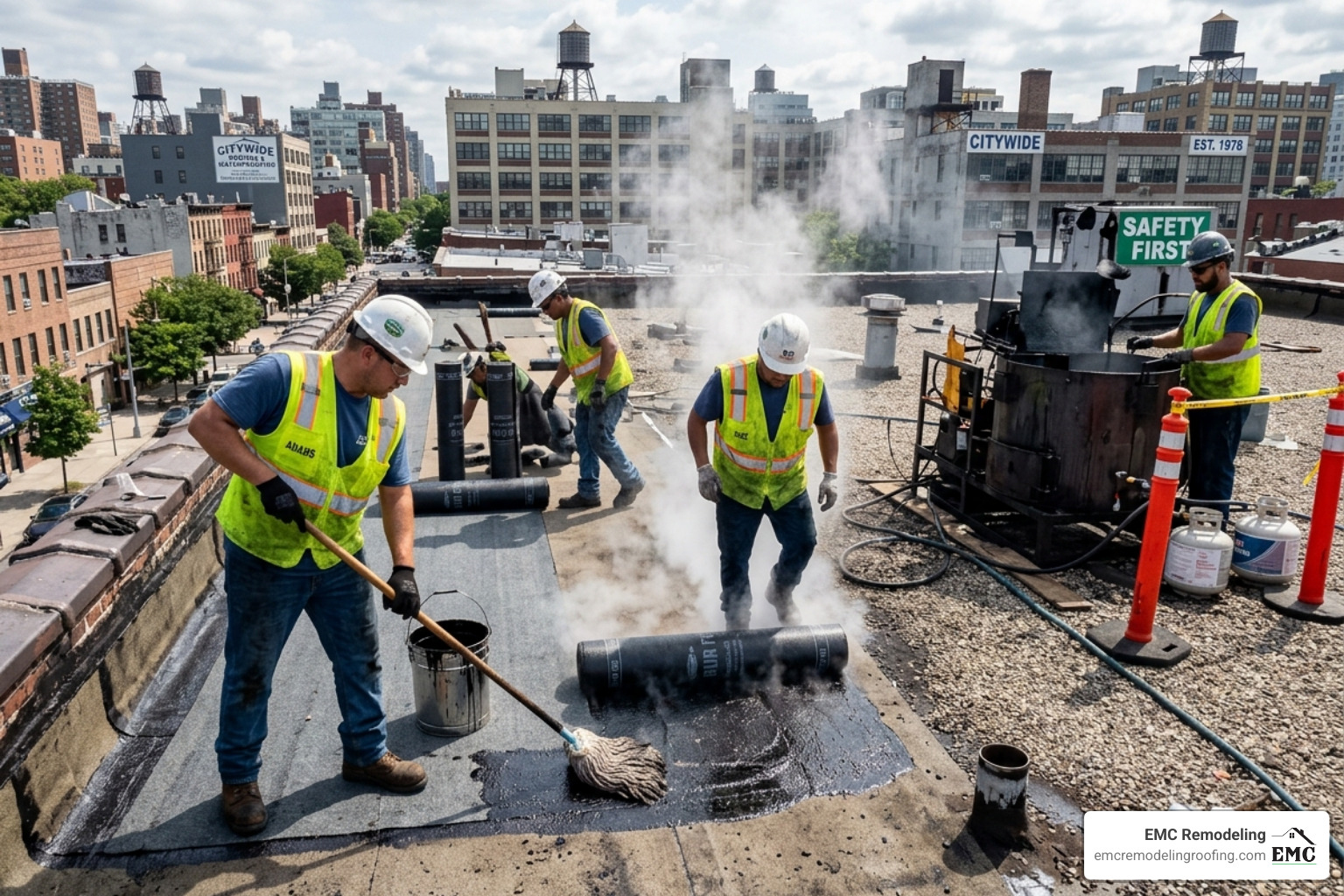
Watching professional hot tar roofers at work is like watching a choreographed dance with 400-degree liquid. The process begins with the “kettle,” where solid blocks of asphalt are melted.
- The Base Layer: We often start with a 28lb fiberglass base sheet, mechanically fastened to the deck using large washers to prevent tearing.
- The Mopping: Hot asphalt is mopped over the base. The roofers must maintain the EVT (355-420°F) to ensure the next layer of felt bonds instantly.
- Ply-Sheet Offsets: Layers of roofing felt are rolled into the hot tar. Each layer is “offset” or overlapped so that seams never line up vertically.
- The Flood Coat: Once the plies are set, a final heavy layer of hot asphalt is applied.
- Gravel Embedding: While the flood coat is still molten, gravel or slag is embedded into the surface. This protects the bitumen from UV rays and provides fire resistance.
For a deeper dive into the technical side of these repairs, refer to our asphalt flat roof repair ultimate guide.
Safety Protocols and Health Considerations
Working with hot tar is dangerous work that requires strict safety standards. Asphalt has a minimum flash point of 575°F according to ASTM D312 standards. Professional hot tar roofers must constantly monitor kettle temperatures to ensure the asphalt stays well below this ignition point.
Beyond fire risks, there are health considerations. Coal tar, in particular, contains high concentrations of Polycyclic Aromatic Hydrocarbons (PAHs), which are known carcinogens. This is why modern crews use fume mitigation, specialized protective gear, and strict handling protocols. It is also why you should never hire a “handyman” for this type of work; the risks to your property and the workers’ health are too high without professional training.
Hot Tar vs. Modern Alternatives: A Comparative Analysis for Optimal Roofing Choices
Many property owners ask if they should stick with traditional hot tar or move to modern materials like TPO (Thermoplastic Polyolefin) or Modified Bitumen.
| Feature | Built-Up Roofing (BUR) | TPO (Single-Ply) | Modified Bitumen |
|---|---|---|---|
| Lifespan | 30-40+ Years | 15-25 Years | 20-30 Years |
| Redundancy | High (Multi-ply) | Low (Single layer) | Moderate (2-ply) |
| Water Resistance | Excellent (even ponding) | Good | Good |
| Installation Risk | High (Hot kettles) | Low (Heat welding) | Moderate (Torches) |
| Annual Cost | Very Low | Moderate | Moderate |
Modern single-ply systems are popular because they are faster to install and lighter. However, they lack the “self-healing” and multi-layered security of a hot tar roof. Furthermore, if you are overlaying an old coal tar roof, you cannot simply roll out a new plastic membrane. Chemical incompatibility will cause the new roof to fail. In these cases, we use DensDeck gypsum boards as a barrier to prevent chemical migration between the old tar and the new system.
Qualifications to Look for in Professional Hot Tar Roofers
Because the use of hot tar has declined in favor of easier-to-install plastics, finding true experts is getting harder. When vetting hot tar roofers, look for:
- Longevity: Has the company been around for at least 20-30 years? BUR is a “legacy” skill passed down through generations.
- Kettle Safety Certification: Ask about their specific training for high-heat equipment.
- Insurance Compliance: Ensure their policy specifically covers “hot work” or open flames/kettles, as many standard policies exclude this.
- Owner Involvement: At EMC Remodeling, we provide direct owner involvement to ensure that every thermal reading and ply-lap meets our family-operated standards.
Extending Your Investment: Maintenance Strategies for a 30-Year Hot Tar Roof Lifespan
A hot tar roof is a tank, but even tanks need oil changes. To get that 40-year lifespan, follow these steps:
- Regular Cleaning: Remove leaves and debris that trap moisture. Even though BUR handles ponding water better than most, excessive organic matter can lead to plant growth that punctures the membrane.
- Inspect for Blisters: “Blisters” happen when air or moisture gets trapped between layers. If you see a bubble, have a professional hot tar roofer repair it before it pops.
- Reflective Coatings: Applying an aluminum or white reflective coating can significantly reduce the surface temperature of the roof, slowing down the oxidation of the asphalt and lowering your cooling bills.
- Puncture Checks: After any HVAC work or heavy storms, check for punctures in the gravel surface.
Your Top Questions Answered: Hot Tar Roofing FAQs
How long does a hot tar roof typically last?
A standard asphalt BUR roof lasts 15-30 years. However, well-maintained coal tar roofs are famous for lasting 40-60 years. The main factors affecting this are the number of plies (more is better), the quality of the surfacing (gravel vs. smooth), and the local weather exposure in Central Texas.
Can hot tar be applied over an existing roof?
Yes, “go-overs” are possible, but they carry risks. You must ensure the existing structure can handle the significant weight of a new multi-ply system. Also, you cannot apply asphalt directly over old coal tar without a separator like DensDeck, as the two materials are chemically incompatible.
Why has the use of hot tar roofing declined?
The decline is mainly due to labor costs and environmental regulations. It takes a larger crew and more specialized equipment to run a hot tar job than a TPO job. Additionally, the fumes and safety risks associated with kettles have led many smaller contractors to abandon the practice entirely.
Partner with EMC Remodeling: Your Trusted Hot Tar Roofing Experts
When it comes to the safety and longevity of your building, you don’t want to take chances with unproven contractors. At EMC Remodeling, we are a family-operated business that treats your commercial property like our own. Whether you need a full BUR installation or an emergency repair after a Texas storm, we are here for you.
We provide:
- 24/7 Emergency Support: Because leaks don’t wait for business hours.
- Expert Craftsmanship: Specialized knowledge in traditional and modern roofing systems.
- Local Trust: Serving Temple, Leander, and the surrounding Central Texas areas with pride.
Don’t let a minor leak turn into a structural disaster. For reliable Temple TX roofing services, trust the experts who know the science of the “hot stuff.”
Schedule a professional roof repair today or call us at 254-771-3600 for a free, no-pressure estimate.
