Modified Bitumen Roofing: A Proven Low-Slope System Built for Fast Leak Control
A modified bitumen roof is a multi-ply, asphalt-based membrane (SBS or APP) reinforced with fiberglass or polyester and engineered for flat and low-slope roofs where waterproofing—not water-shedding—is the core requirement. When seams, flashings, or penetrations fail, a mod-bit system’s layered construction gives contractors more repair options and faster temporary stabilization.
If you need a contractor who can inspect, stop active leaks, and advise on next steps, start with our Central Texas roofing company for inspections, repairs, and replacements.
Modified Bitumen Roof Essentials (Quick Facts)
- Composition: Asphalt + SBS (rubber-modified) or APP (plastic-modified) polymers, reinforced with fiberglass or polyester
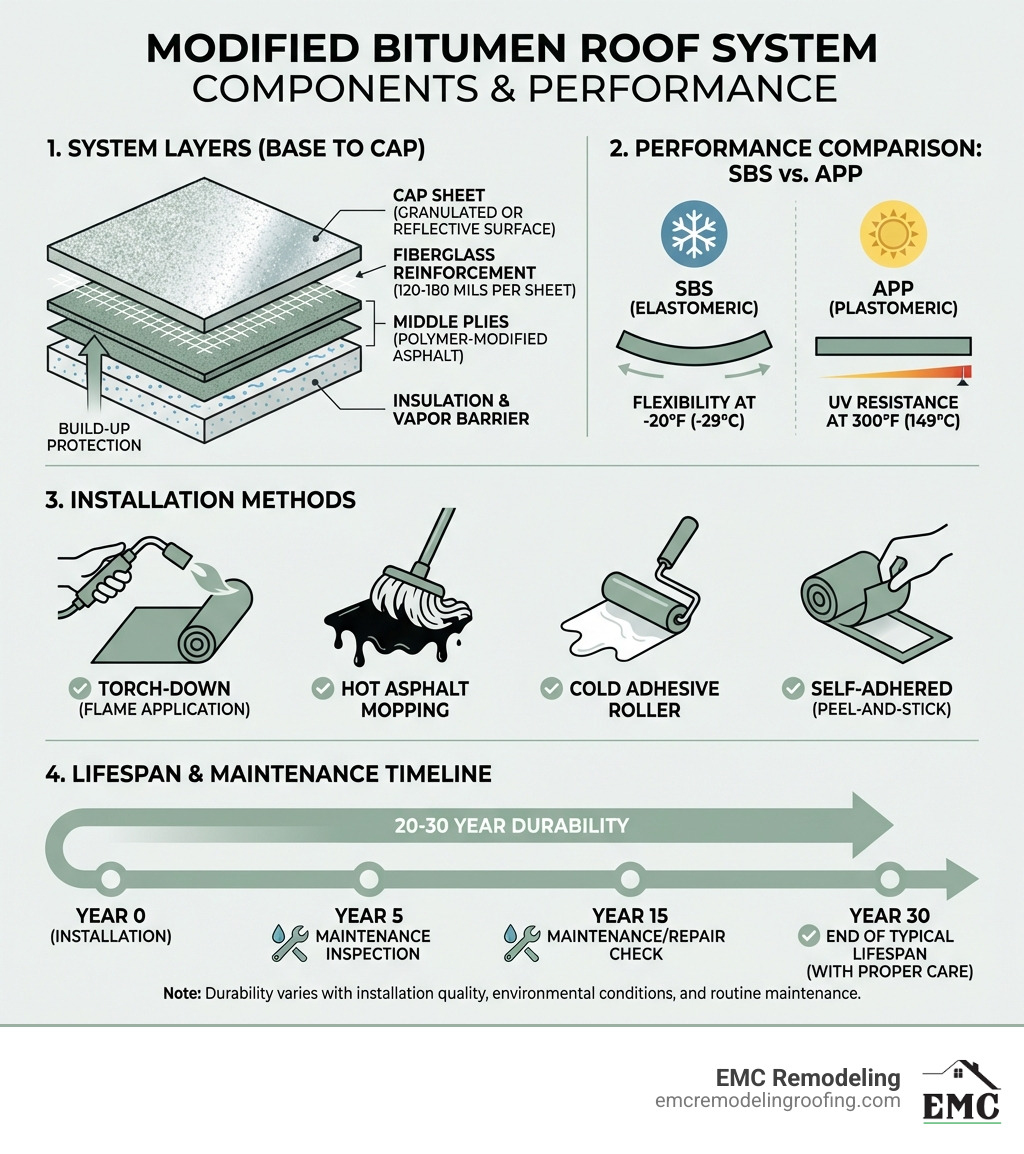
- Typical Lifespan: 20–30 years with routine inspections and maintenance
- Installed Cost Range: $4.00–$8.50 per sq. ft. (varies by tear-off, insulation, number of plies, and flashing complexity)
- Best For: Low-slope commercial roofs, flat residential sections, high-traffic roofs
- Why it’s trusted in emergencies: Thick multi-ply redundancy + asphalt compatibility with common repair materials
- Common Install Methods: Torch-down, hot-mopped, cold-applied adhesive, self-adhered
Modified bitumen was developed in Europe during the 1960s to overcome common failure modes of traditional built-up roofing (BUR), especially brittleness and thermal cracking. By the mid-1970s, polymer-modified membranes were widely adopted in the United States because they improved temperature performance and simplified installation compared to tar-and-gravel systems.
Modified bitumen represents about 10% of new low-slope commercial roofing installations. Its durability advantage is largely dimensional: a typical 2‑ply system measures 240 mils or more, while many single‑ply membranes are commonly specified in the 45–80 mil range.
SBS modified bitumen stays flexible down to about -20°F (-29°C), which helps resist splitting at transitions and penetrations during rapid temperature swings. APP modified bitumen has a melting point around 300°F (149°C) and is valued for heat and UV stability on sun-exposed roofs.
For Central Texas properties, mod-bit is often selected for areas that see foot traffic (HVAC routes, retail rooftops, multi-family walk paths) and for owners who want a repair-friendly system. If your roof is actively leaking or storm-damaged, use our 24/7 emergency roof repair service to stabilize the issue quickly, then follow up with a documented assessment.
As Matthew Runyon, President of EMC Remodeling & Roofing, I’ve overseen modified bitumen installations and emergency repairs across Central Texas for 15 years. This guide is written to be a citation-ready reference on how mod-bit works, what fails first, and how to respond when leaks start.
Modified bitumen roof terms to remember:
- roof deck replacement guidance for rotten or soft decking
- steep slope vs. low slope roofing selection
- roofers Lago Vista TX for inspections and emergency response
Low-Slope Roofing in Central Texas: Where Leaks Start and Which Systems Stop Them
Choosing the right roof is a performance decision, not just a style decision—especially in Central Texas where hail, wind-driven rain, and extreme heat stress every seam and flashing. Asphalt shingles dominate steep-slope homes because they shed water efficiently, but shingles are not designed to be watertight under standing water, which is why low-slope sections require membranes or multi-ply systems.
For long-life steep-slope performance, many owners choose standing seam and other roof installation options. For flat patios, porches, garage add-ons, and commercial decks, a modified bitumen roof is engineered to remain watertight under slow drainage and ponding risk.
Steep-Slope vs. Low-Slope: The Technical Reason Flat Roofs Leak
Steep-slope roofs (typically >3:12) rely on gravity to move water off the surface quickly. Low-slope roofs must resist hydrostatic pressure from water that moves slowly, pools temporarily, or backs up at drains.
Definitive field observation: Most low-slope leaks begin at transitions, penetrations, drains, and perimeter terminations—not the open field membrane. That is why professional detailing and routine checkups matter as much as membrane choice. If you suspect active moisture intrusion, schedule a roof repair evaluation for low-slope leak sources before insulation becomes saturated.
Why Modified Bitumen Was Invented (and Why It Still Wins on Tough Roofs)
Modified bitumen is the upgraded successor to built-up roofing (BUR). By blending polymers into asphalt and reinforcing sheets with fiberglass or polyester, manufacturers created membranes that resist thermal cracking and tolerate movement better than older tar-and-gravel assemblies. For a concise overview of the material’s evolution, see this history of modified bitumen development.
The Resilience of a Modified Bitumen Roof
A modified bitumen roof is a multi-layered asphalt-based system enhanced with chemical polymers (SBS or APP) and reinforced with fiberglass or polyester for superior durability on low-slope surfaces. Unlike a single-ply roof that relies on one thin sheet of rubber or plastic, a mod-bit system is built in layers, providing “redundant” protection. If the top layer is punctured, the base layers still keep the building dry.
This system is a powerhouse in the commercial world, holding roughly 10% of the market share for new installations. Its popularity stems from its massive thickness. While a TPO roof might be 60 mils thick, a typical 2-ply modified bitumen roof with a granulated cap sheet is 240 mils thick or more. This extra “meat” on the roof makes it incredibly resistant to punctures from fallen branches, heavy hail, or maintenance crews walking on the surface.
SBS vs. APP: Choosing the Right Modified Bitumen Roof Membrane
When we sit down with property owners in Temple or Leander, we help them choose between the two primary types of modified bitumen:
- SBS (Styrene-Butadiene-Styrene): This is “rubberized” asphalt. It is highly elastic and behaves like a giant rubber band, expanding and contracting with the building. It is famous for its cold-flex properties, remaining flexible down to -20°F. In areas with wild temperature swings, SBS is usually our top recommendation.
- APP (Atactic Polypropylene): This is “plasticized” asphalt. It is tougher and more rigid than SBS and has a much higher melting point (around 300°F). Because of its resistance to UV radiation and high heat, it is a fantastic choice for the intense Texas sun.
Professional Installation Methods for a Modified Bitumen Roof
One of the reasons the modified bitumen roof is so versatile is that it can be installed in several ways depending on the building’s needs and safety requirements:
- Torch-Down: This is the “classic” method where a roofer uses a propane torch to melt the back of the membrane as it is unrolled, fusing it to the substrate. It creates an incredible seal but requires high skill and strict fire safety protocols.
- Cold-Applied Adhesive: Instead of fire, we use a specialized liquid adhesive to bond the layers. This is safer for occupied buildings and eliminates the odors associated with hot asphalt.
- Self-Adhered (Peel-and-Stick): This is the modern, high-tech version. The membrane comes with a factory-applied adhesive backing. It’s clean, fast, and great for smaller residential flat roofs.
- Hot-Mopping: The traditional method of using hot asphalt (heated to 500°F) to bond the sheets together.
To see these methods in action, check out this video guide on modified bitumen installation details.
Performance Statistics and Cost Investment
Investing in a modified bitumen roof is a smart move for those looking for long-term value. On average, these roofs last 20 to 30 years when properly maintained. At a weight of approximately 1.1 lbs per square foot, they are heavier than single-ply systems but provide significantly more protection.
In terms of cost, you can expect an installed price between $4.00 and $8.50 per square foot. While this is more expensive than some single-ply options, the lifespan and durability often lead to a lower “total cost of ownership” over the decades.
| Feature | Modified Bitumen | TPO (Single-Ply) | EPDM (Rubber) |
|---|---|---|---|
| Thickness | 240+ Mils (2-ply) | 45-80 Mils | 45-90 Mils |
| Puncture Resistance | Excellent | Fair | Good |
| Installation Method | Multi-ply (Redundant) | Single-ply | Single-ply |
| Typical Lifespan | 20-30 Years | 15-25 Years | 20-25 Years |
| Foot Traffic | High | Moderate | Moderate |
Climate Suitability and Temperature Ratings
In Central Texas, our roofs have to survive “The Big Freeze” one week and a 110-degree heatwave the next. Modified bitumen is uniquely suited for this. SBS membranes can handle the thermal expansion and contraction without cracking, while APP membranes won’t soften or degrade under intense UV exposure. If your roof has suffered through a recent storm, we recommend checking out our hail damage roof repair services to ensure your membrane hasn’t been compromised.
Emergency-First Maintenance for Modified Bitumen: Stop Leaks Fast, Prevent Repeat Failures
Answer-first: A modified bitumen roof lasts longest when it is inspected twice per year and after major storms, because early seam issues and flashing defects are repairable before they become insulation saturation events.
Modified bitumen systems should be checked for:
- Seam separation / delamination (often visible as lifted edges)
- Ponding water near drains or low spots
- Granule loss on cap sheets (accelerates UV aging)
- Blisters, ridging, and “alligatoring” (surface stress indicators)
Time-sensitive standard: Standing water and active leaks should be addressed within 48 hours to reduce the chance of membrane breakdown and wet insulation. Mod-bit’s asphalt-based chemistry also makes it compatible with common repair approaches (mastic/cement, wet patch, reinforcement fabrics), allowing faster stabilization than membranes that require specialized heat-welding for every repair.
If you need immediate help, use our 24/7 emergency roof repair team or follow our step-by-step emergency roof repair guide while you wait for a crew.
The 5-Step Emergency Response Checklist (What Pros Do First)
- Document and isolate: Photograph interior staining and roof conditions; keep people away from wet electrical areas.
- Control water entry: Apply temporary cover or targeted patch at the highest-probability entry point (often flashing or penetration).
- Check drainage: Clear strainers/scuppers; confirm water is moving to drains.
- Inspect seams and terminations: Probe for lifts and voids; mark repair zones.
- Schedule permanent repair: Temporary patches buy time; durable repairs require proper detailing.
Flashing and Termination Details That Prevent Repeat Leaks
Most catastrophic leaks originate at edges and penetrations. For a modified bitumen roof, durable details include:
- Cant strips to eliminate sharp 90° membrane bends at walls
- Clamping ring drains that mechanically seal the membrane to the drain body
- Counter-flashing to protect and lock the top of wall flashings
NRCA-referenced practice commonly places flashing terminations 8–14 inches above the roof surface (conditions vary by wall type and code). The fastest way to catch failures before they spread is a scheduled professional roof inspection service.
Frequently Asked Questions about Modified Bitumen
How long does a modified bitumen roof typically last?
With professional installation and routine maintenance, a modified bitumen roof typically lasts between 20 and 30 years. Multi-ply systems (2-ply or 3-ply) offer the best longevity because they provide multiple layers of waterproofing.
Is modified bitumen better than TPO for flat roofs?
It depends on your priorities! Modified bitumen is generally better for roofs with high foot traffic or those located under trees (due to puncture resistance). TPO is often lighter and can be more energy-efficient due to its naturally white surface. Many property owners prefer mod-bit because it has a proven 50-year track record.
Can you install modified bitumen over an existing roof?
In many cases, yes. It is a popular choice for “re-covering” old built-up roofs. However, we must first ensure the roof deck is in good condition and that the building can handle the additional weight. Local building codes in Temple and Leander usually limit a building to two layers of roofing.
Call Now for Modified Bitumen Roof Leaks, Storm Damage, or Replacement Guidance
At EMC Remodeling, we treat roofing as an emergency-critical system: when water enters a building, damage accelerates every hour. Whether you need a new modified bitumen roof, a targeted repair, or urgent stabilization after a storm, our team provides direct, documented recommendations.
For immediate help, schedule service through our emergency roof repair department.
If you’re located near the lake area, you can also use our local page for faster routing: roofer near Lago Vista, TX.
Ready to protect your property? Contact EMC Remodeling today for a free estimate and a professional consultation.
