What Does It Really Cost to Refelt a Roof? (2026 Emergency & Planned Refelting Guide)
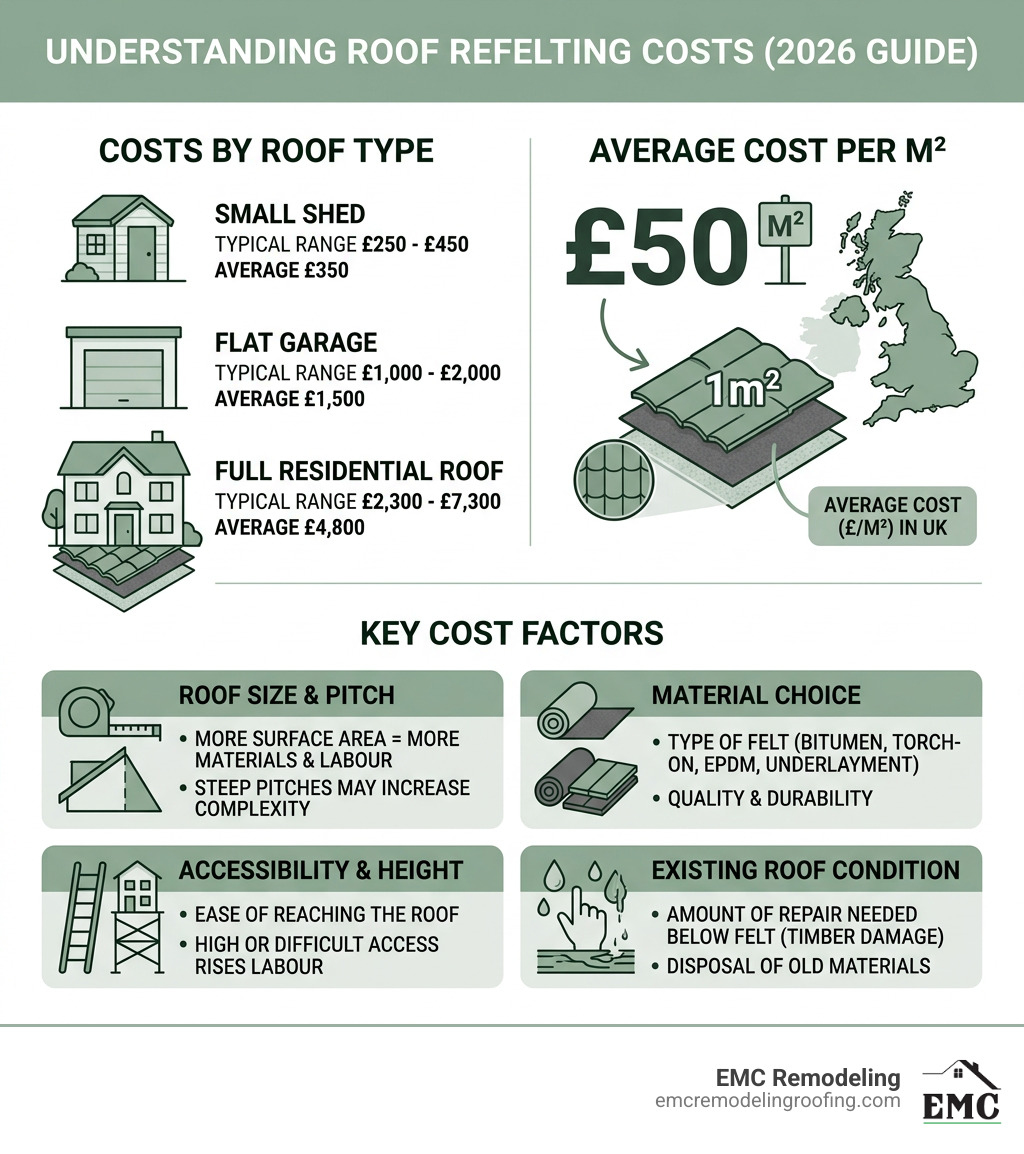
The cost to refelt a roof typically ranges from £250 for a small shed up to £7,300 for a full residential roof, with most homeowners paying around £50 per square metre on average in the UK. As leading professional roofing contractors in Central Texas, EMC Remodeling provides these estimates to help homeowners budget for both planned maintenance and emergency roof repair situations that demand immediate action.
Here’s a quick snapshot of what to expect:
| Roof Type | Typical Cost Range | Average Cost |
|---|---|---|
| Small shed | £250 – £450 | £350 |
| Flat garage roof | £1,000 – £2,000 | £1,500 |
| Full roof under tiles | £2,300 – £7,300 | £4,800 |
| Small patch repair (~4m²) | £150 – £250 | £200 |
| Labour (per day) | £150 – £250 | £200 |
These numbers vary based on your roof size, pitch, materials, and accessibility. We’ll break down every factor in detail below.
Roof felt is your home’s silent defender. It sits beneath your tiles as a secondary waterproof barrier, blocking wind, rain, moisture, and even pests from reaching your home’s structure. According to the National Roofing Contractors Association, over 40% of all building-related problems are caused by water intrusion, and failed underlayment is a leading contributor. When felt fails, the damage escalates fast — water intrusion, rotting rafters, and sagging ceilings are all common consequences of neglected roof felt.
Yet most homeowners don’t think about their roof felt until something goes wrong. A water stain on the ceiling. A musty smell in the loft. By then, a simple refelting job may have turned into a much bigger repair bill requiring professional roof repair services.
Whether you’re dealing with a leaking roof right now or planning ahead, understanding the expert roofing services available in Temple, TX — and what they cost — puts you in control.
I’m Matthew Runyon, President of EMC Remodeling & Roofing, and with over 15 years of hands-on roofing experience, I’ve helped countless homeowners navigate the real cost to refelt a roof and make smart decisions before small problems become expensive ones. If you need immediate assistance, call us at 254-327-6865 for a free consultation. In the sections below, I’ll walk you through everything you need to know to budget confidently for your project.
Cost to refelt a roof vocab explained:
2026 Average Roof Refelting Costs: Data-Backed Pricing by Property Type
The average cost to refelt a roof in 2026 is approximately £50 per square metre, though total project prices vary significantly based on the structure’s scale. Refelting a small garden shed is a world away from stripping the tiles off a four-bedroom detached home. For a standard 3-bedroom semi-detached house, a full refelt under existing tiles typically averages around £4,800. Industry data shows that refelting costs have risen approximately 8-12% since 2023 due to increased material and labour expenses.
If you are dealing with a flat roof, such as a garage, the numbers shift. A flat garage roof refelt usually costs between £1,000 and £2,000. If you’re just looking to spruce up a medium-sized shed, expect to pay between £250 and £450. It’s important to distinguish between “patching” and “replacing.” A small patch repair (covering about 4m²) can be handled for roughly £200, but if the felt is brittle across the whole structure, patching is often just putting a bandage on a broken leg.
For those planning a larger project, our detailed roof estimate cost guide provides deeper insights into how these figures scale with property size. You can also find more specific data on the cost of replacing roof felt under tiles to help refine your budget.
Typical Price Breakdown for Materials and Labor
To understand where your money goes, you have to look under the hood—or in this case, under the tiles. A standard refelting quote isn’t just for the felt itself. Here is a typical breakdown:
- Felt/Underlayment Rolls: High-quality breathable membranes or traditional bitumen felt.
- Timber Battens: These are almost always replaced during a refelt because they often rot alongside the old felt.
- Scaffolding Hire: This is a major cost driver, often ranging from £800 to £2,000 depending on the height and complexity of your home. Scaffolding alone accounts for 15-25% of total project costs on average.
- Waste Disposal: Skip hire for old felt, rotten wood, and broken tiles.
- Labor: The physical work of stripping, prepping, and reinstalling.
For a granular look at material pricing, the Homewyse Calculator for Roofing Felt Paper is an excellent resource for checking current market rates for supplies.
Regional Variations in Roofing Quotes
Where you live matters just as much as what you’re building. In the UK, London and the South East carry a significant premium on labor, often adding 10-20% to the total bill.
In our service areas of Temple and Leander, TX, the cost to refelt a roof is influenced heavily by intense UV exposure and sudden hailstorms that accelerate underlayment aging. Texas experiences an average of 9 significant hail events per year in Central Texas alone, making underlayment integrity a critical safety concern. While UK residents might worry about dampness, we focus on thermal barriers and high-temperature underlayments that withstand the Texas sun. If you’re in the Killeen area, our local roofing team in Killeen, TX can provide a localized price. Getting an accurate estimate for roof repair from a local pro is the only way to account for these environmental factors.
Critical Factors That Determine Your Roof Refelting Estimate
The total cost to refelt a roof is determined by four primary variables: roof size, pitch steepness, accessibility, and the presence of existing structural damage. Research from the Insurance Institute for Business & Home Safety (IBHS) confirms that underlayment condition is one of the top three factors in a roof system’s ability to withstand severe weather events.
- Roof Size: This is the most obvious factor. More square footage equals more materials and more hours on the clock. A typical UK home has between 50m² and 120m² of roof area.
- Pitch Steepness: A “walkable” roof is much cheaper to work on than a steep, high-pitched roof that requires specialized safety harnesses and more complex scaffolding. Roofs above a 7:12 pitch can add 20-30% to labour costs.
- Accessibility: If a roofer can’t get a skip or scaffolding close to the house, labor costs rise because of the extra time spent moving materials.
- Structural Damage: If we pull back the felt and find rotten rafters or joists, the scope of work changes instantly. Approximately 1 in 4 refelting projects uncovers some degree of timber damage requiring additional repair.
Proper moisture management is critical here. According to the Moisture Control Guidance for Building Design, failing to address underlying moisture issues during a refelt can lead to premature failure of the new materials. For a comprehensive look at how these factors combine, check out our complete guide to roof replacement estimates.

How Material Choice Impacts the Cost to Refelt a Roof
The type of “felt” you choose isn’t just about price; it’s about performance and long-term protection against emergency roof failures.
- Traditional Bitumen Felt: The “old school” choice. It’s cheaper but can become brittle over time and doesn’t breathe. Average lifespan: 10-15 years.
- Breathable Membranes: The modern standard. They allow moisture to escape from your attic while keeping liquid water out. They cost more upfront but prevent rot. Average lifespan: 25-30 years.
- Torch-on Felt: Primarily for flat roofs, this involves three layers heat-sealed together for a watertight finish. Average lifespan: 15-20 years.
- EPDM Rubber: A premium alternative for flat roofs that can last over 30 years with minimal maintenance.
The HUD PATH Rehab Guide on Roofs offers a deep dive into how different underlayment materials perform across various climates and building types. For homeowners considering a full roof installation, material selection at the underlayment stage is one of the most consequential decisions you’ll make.
Hidden Costs and Structural Repairs
The “hidden” part of the cost to refelt a roof usually lives in the timber. When felt fails, water sits on the wooden battens and rafters. We often find that what looked like a simple felt replacement requires new timber battens or even rafter repairs.
Other “while you’re at it” costs include:
- Chimney Repointing: If the scaffolding is up, it’s the perfect time to fix crumbling mortar.
- Guttering: Replacing old gutters while the bottom row of tiles is off is much more efficient.
- Fascia and Soffit Repair: Often damaged by water overflowing from failed felt.
For more on these secondary repairs, see our roof eaves repair cost guide.
The 6-Stage Professional Process for Replacing Roof Underlayment
The professional process of replacing roof underlayment involves six distinct stages: site preparation, tile stripping, structural inspection, membrane installation, battening, and reroofing. This systematic approach ensures the secondary water barrier is perfectly sealed and meets current building code requirements.
- Preparation: Scaffolding is erected, and the site is secured. This stage typically takes half a day for a standard residential property.
- Stripping: Tiles are carefully removed and stacked (if being reused). Old battens and the deteriorated felt are stripped away. On average, 5-10% of tiles will need replacement due to breakage during handling.
- Inspection: We check the rafters for rot or structural issues. This is the most critical stage — skipping it is the number one cause of premature refelt failure.
- Installation: New felt (usually a breathable membrane) is laid in overlapping horizontal strips, starting from the bottom. Overlaps must be a minimum of 100mm to ensure watertight performance.
- Battening: New treated timber battens are nailed over the felt.
- Tiling: Tiles are re-laid, and any broken ones are replaced.
For those with tile roofs, the cost to replace underlayment on tile roof involves significant labor because every tile must be handled twice.
Labor Rates and the Daily Cost to Refelt a Roof
In the roofing world, you usually pay for a “team” rather than a single individual. Daily rates for a two-person crew typically range from £150 to £250 per person, meaning you should budget around £300 to £500 per day in labor.
A full house refelt usually takes 2 to 3 days of active labor, assuming the weather cooperates. The Bureau of Labor Statistics reports that roofing is among the top 10 most physically demanding occupations, which directly impacts the skilled labour rates you’ll see in quotes. If you’re interested in how contractors build these quotes, the Journal of Light Construction’s guide on unit-price systems explains the math behind the madness.
Flat Roof Felt Replacement vs. Pitched Roof Underlayment: Key Differences
Flat roofs are a different beast. Unlike pitched roofs where the felt is a “secondary” barrier, on a flat roof, the felt is the primary barrier. Flat roofs account for approximately 25% of all emergency roof leak calls because of this single-layer vulnerability. This usually requires a three-layer system:
- Vapor Control Layer: Nailed or bonded to the deck.
- Reinforced Felt Layer: The “meat” of the system.
- Cap Sheet: A mineral-surfaced layer that protects against UV rays.
The garage roof replacement cost guide breaks down these specific flat-roof expenses in more detail.
5 Warning Signs Your Roof Felt Needs Emergency Replacement
Roof felt requires immediate replacement when it becomes brittle to the touch, allows internal dampness on rafters, or shows visible tears that permit light into the loft space. Data from insurance claims analysis shows that 60% of interior water damage claims originate from failed or deteriorated roof underlayment. You don’t always need to wait for a waterfall in your living room. Look for these red flags:
- Brittle Texture: If you touch the felt in your loft and it crumbles like a dry biscuit, it’s done. This is the most reliable indicator of end-of-life underlayment.
- Internal Dampness: Dark spots on rafters or insulation. Moisture content above 20% in timber indicates active water intrusion.
- Light Peeking Through: If you see daylight in the loft (and it’s not a vent), your felt has likely torn.
- Pest Issues: Rodents and birds love torn felt as an entry point. The presence of nesting material in your loft is a strong secondary indicator.
- Sagging Between Rafters: Felt that hangs in “pockets” is collecting water and will eventually fail catastrophically.
If you see these signs during a storm, you may need emergency roof repair services to prevent structural collapse. Call 254-327-6865 for 24/7 emergency support.
Lifespan and Durability of Modern Felt Materials
Traditional felt lasted about 10-15 years. Modern high-performance membranes can easily go 25-30 years if installed correctly. Factors like heat (a big one in Texas!) and ventilation play a huge role in this lifespan. According to the Bureau of Labor Statistics, hiring qualified professionals ensures that these high-tech materials are handled according to manufacturer specs, which is vital for keeping your warranty valid. In Central Texas, where summer roof surface temperatures can exceed 160°F (71°C), selecting UV-resistant underlayment is not optional — it’s essential.
The Financial Case for Proactive Refelting
Why spend thousands now? Because it saves tens of thousands later. Industry data consistently shows that every £1 spent on preventive roof maintenance saves £5-£10 in emergency repairs. Proactive refelting:
- Prevents Rafter Rot: Replacing a few beams is cheap; replacing a whole roof structure is not. Rafter replacement alone can cost £1,500-£4,000.
- Boosts Energy Efficiency: Modern membranes help regulate attic temperatures, reducing heating and cooling costs by up to 15%.
- Increases Property Value: A “newly felted” roof is a massive selling point for buyers and can add 3-5% to a home’s resale value.
Understanding the cost to fix a roof before the damage spreads is the hallmark of a savvy homeowner.
Frequently Asked Questions about Roof Refelting
Can you replace roof felt without removing tiles?
No, roof felt cannot be replaced without removing the tiles because the underlayment is installed directly beneath the timber battens that secure the tiles to the rafters. While some “patching” can be done from the inside in emergencies, it is not a long-term solution and won’t be watertight. A full replacement requires a clear workspace to ensure the new membrane is properly overlapped and sealed.
How long does it typically take to refelt a roof?
A standard residential refelting project typically takes between 1 to 3 days to complete. A small garage can often be finished in a single day, while a large, complex roof with multiple valleys and chimneys might stretch to 4 or 5 days, depending on weather conditions and crew size.
What is the most common cause of roof felt damage?
The most common cause of roof felt damage is age-related degradation and prolonged UV exposure, which strips the bitumen of its oils and causes the material to become brittle. In Central Texas, high heat accelerates this process, causing the felt to crack and split long before the tiles themselves fail.
Protect Your Home Today: Schedule Professional Roof Refelting Before the Next Storm
The cost to refelt a roof is a critical investment in your home’s structural longevity and moisture protection. Studies show that homes with properly maintained underlayment experience 70% fewer interior water damage incidents compared to those with deteriorated felt. While it might seem like a large expense today, it is the single best way to reduce the risk of structural water damage, mould growth, and timber decay caused by recurring leaks.
At EMC Remodeling, we are a family-operated business based right here in Temple, TX. We bring exceptional craftsmanship and direct owner involvement to every job, whether it’s a small repair, a full professional roof replacement, or emergency storm damage response. We understand the unique challenges of Texas weather and provide 24/7 emergency support when you need it most.
If you’re seeing active leaking, stained ceilings, or damp decking, don’t wait for the next storm to escalate the damage. Call us today at 254-327-6865 or request a transparent, itemised quote and fast scheduling so you can stabilise the roof system before insulation, rafters, or interior finishes are affected.
