Why Your Roof Deck is the Foundation of Your Home’s Protection
Roof deck replacement means removing and reinstalling the structural wood layer (decking) that sits on your rafters and supports your shingles. It becomes necessary when leaks, rot, or sagging wood weaken the roof’s structure and safety. For Central Texas homeowners, EMC Remodeling in Temple and Leander handles the entire process, from emergency protection and diagnosis to full deck replacement and complete roof restoration.
Quick Answer for Homeowners:
- What it is: The wooden boards (plywood or OSB) that sit on top of your rafters, creating the base for all other roofing materials
- When you need it: Water stains on ceilings, sagging rooflines, spongy spots when walking on the roof, or musty attic odors
- Cost factors: Material type (sheet vs. plank), extent of damage, and labor rates in your area
- The 30% rule: If 30% or more of your decking shows deterioration during inspection, full replacement is typically more cost-effective than spot repairs
- Who should do it: Always hire a professional—this is dangerous, structural work that requires expertise and proper safety equipment
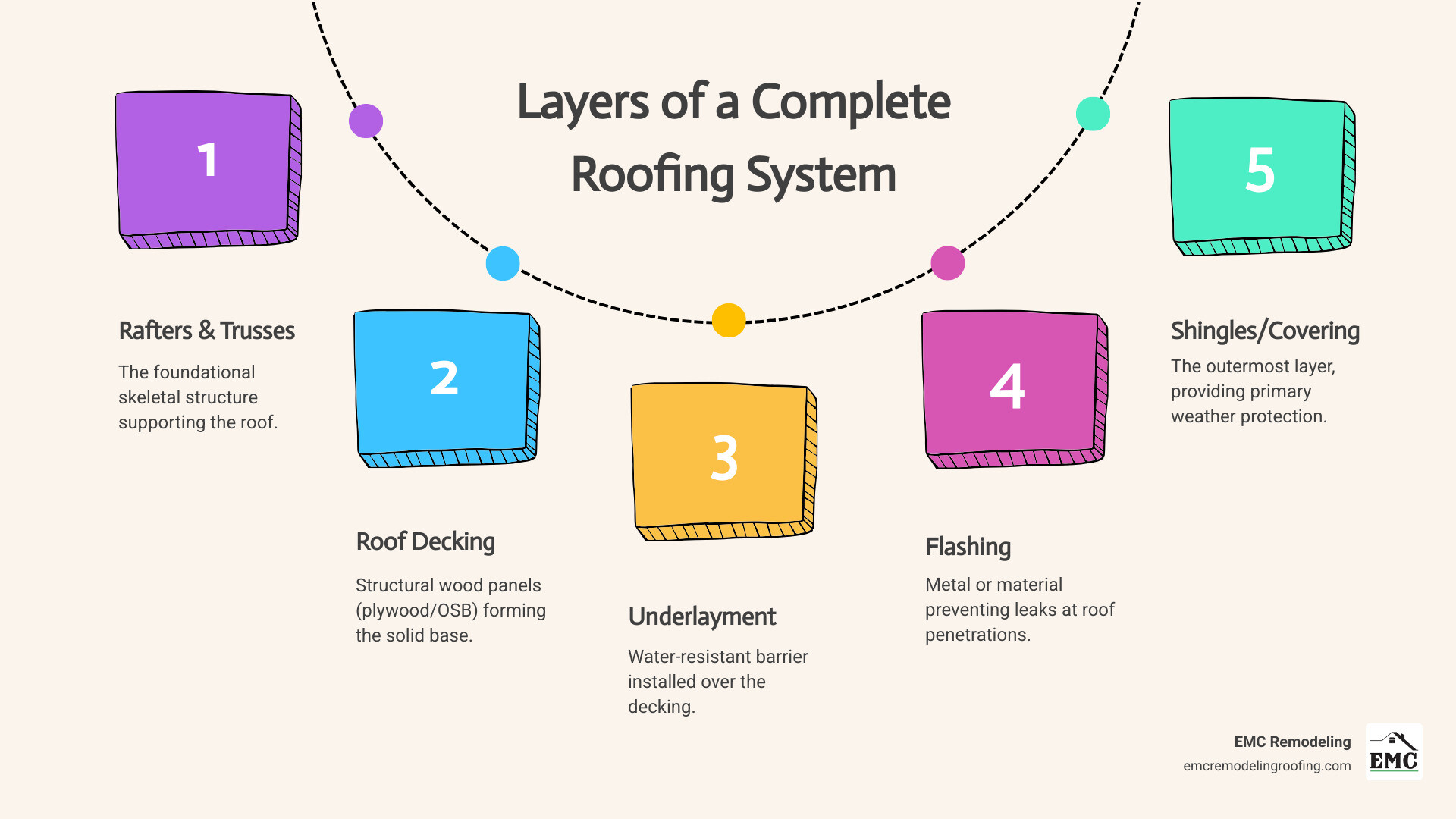
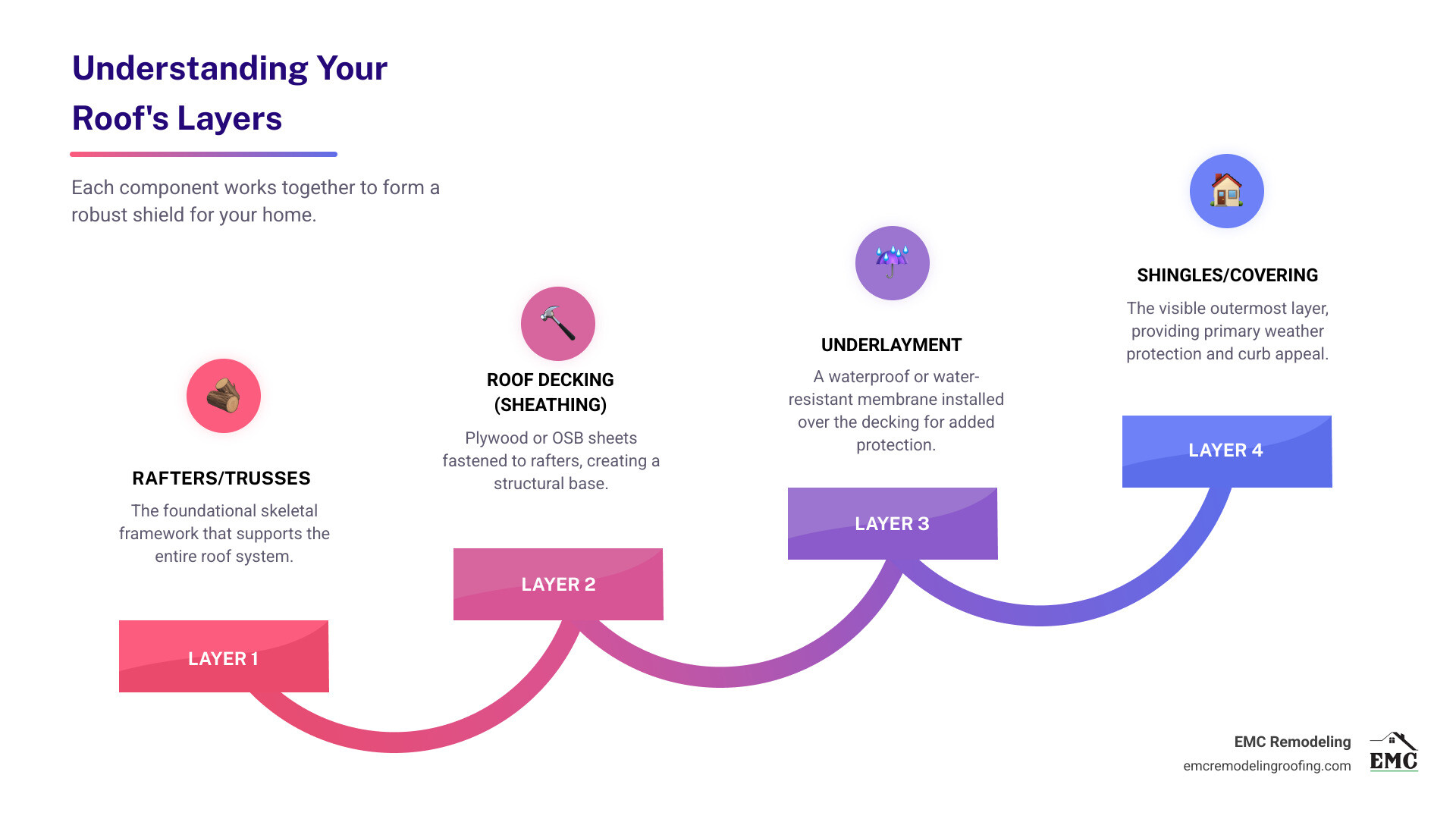
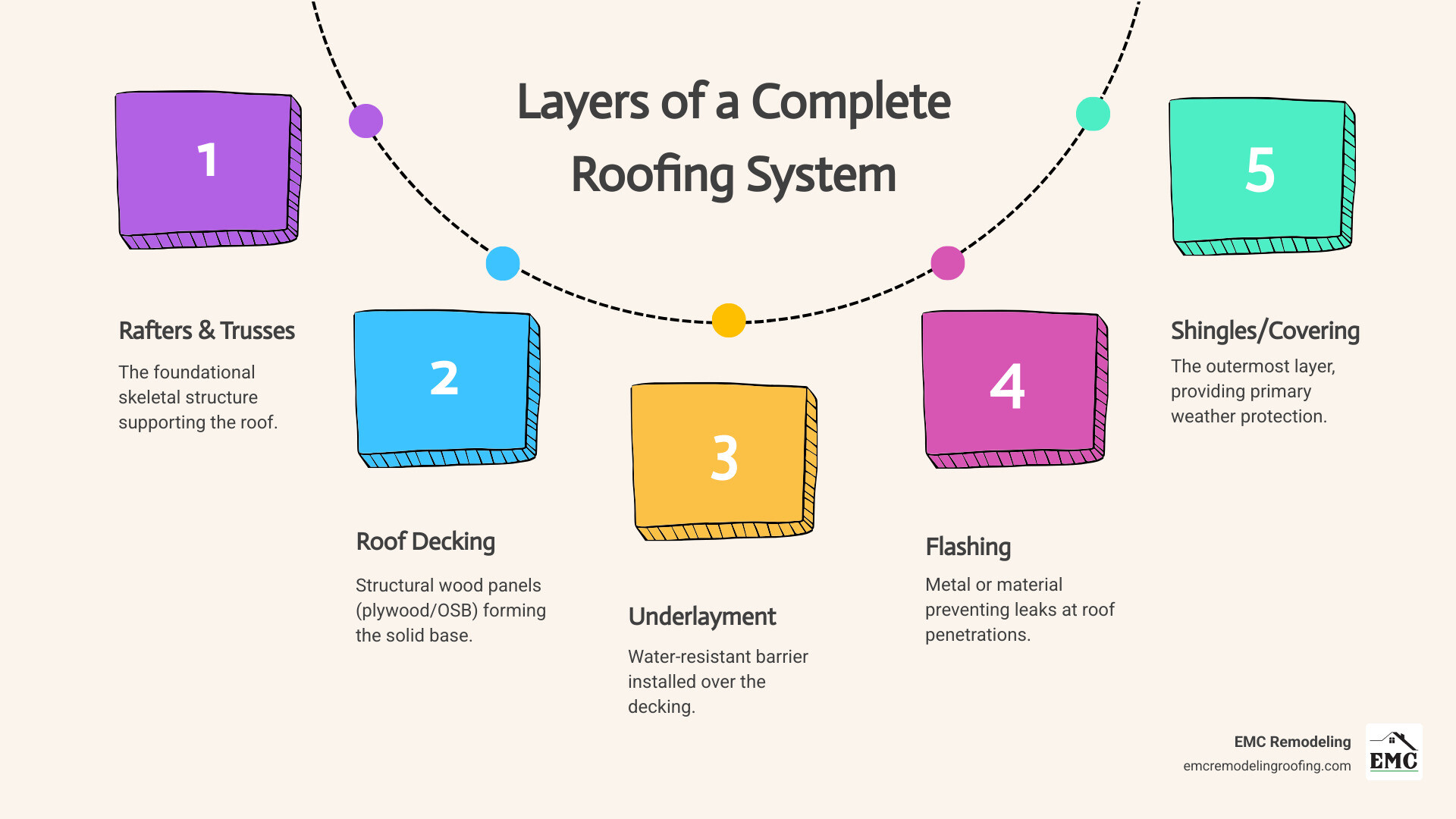
Your home’s roof is its first line of defense against Central Texas weather, and the foundation of that defense is the roof decking. This structural layer—also called roof sheathing—sits directly on top of your rafters and trusses, creating the solid base that supports your underlayment, shingles, and everything else. As your trusted Temple roofing experts, we know that without sound decking, even the highest-quality shingles cannot protect your home. Water damage, poor ventilation, and age can all compromise this critical layer, leading to costly structural problems that extend far beyond the roof itself.
The decking serves two essential functions: it provides structural integrity to support the weight of your roofing materials and any environmental loads like snow or wind, and it acts as the first weather barrier protecting your home’s interior. When this foundation fails, the consequences cascade quickly—from interior water damage to compromised structural framing.
This guide covers everything Central Texas homeowners need to know about identifying damage, understanding the replacement process, navigating building codes, and making informed decisions about costs and professional services. Whether you’re dealing with an emergency situation or planning proactive maintenance, understanding your roof deck is essential to protecting your investment.
I’m Matthew Runyon, President of EMC Remodeling & Roofing in Temple, Texas, and over my 15 years in the roofing industry, I’ve overseen countless roof deck replacement projects across Central Texas, from storm-damaged homes to aging systems that simply reached the end of their lifespan. My team and I understand the unique challenges our climate presents to roof decking, and we’re committed to helping homeowners make informed decisions about this critical component of their homes.
Need immediate help with your roof? Contact EMC Remodeling 24/7 at 254-265-6163 for emergency roofing services in Temple, Killeen, and throughout Central Texas.
Identifying the Need for a Roof Deck Replacement: Don’t Let Hidden Damage Linger
Your roof is only as strong as what’s beneath it. Compromised decking puts every shingle above it at risk. Just like the foundation of your home, your roof decking is critical, and timely repairs or a roof deck replacement are paramount. This section covers the critical signs and causes of decking failure, helping you determine if you need spot repairs or a full replacement.
Telltale Signs of Damaged or Rotted Decking
Roof decking damage can be elusive, often hiding beneath layers of roofing materials. However, your home has ways of telling you when there’s an issue. Here are the clear indicators we look for:
- Water stains on ceiling: This is a classic, unmistakable sign that water has penetrated through your roofing system, reaching and soaking into your decking. These stains can appear as dark spots, rings, or discolored areas on your interior ceilings.
- Sagging roofline: If you notice dips or visible sags in your roof from the exterior, it’s a strong indication that the underlying decking has lost structural integrity, likely due to moisture saturation and rot.
- Spongy or soft spots on the roof: When walking on your roof (which we only recommend for professionals!), if you feel areas that give way or feel soft and springy underfoot, that decking is compromised. This “lack of underfoot rigidity” means the wood is no longer solid.
- Musty odors in the attic: A persistent damp or musty smell in your attic or upper rooms is a red flag for hidden moisture and potential mold or mildew growth on your decking.
- Discolored or dark wood: If you can access your attic, examine the underside of your roof deck. Dark, discolored spots, especially around vents, chimneys, or valleys, signify water intrusion and the beginning stages of rot.
- Crumbling wood: In advanced stages of rot, the wood decking may become brittle and crumble easily when touched. This is a severe structural issue.
- Mold or mildew growth: Any visible mold or mildew on the attic side of your decking points directly to excessive moisture and inadequate ventilation, which are prime conditions for wood rot.
Common Causes of Decking Failure: The Usual Suspects
Understanding why decking fails helps us prevent future issues and correctly address current ones. The primary culprits are usually moisture-related:
- Persistent roof leaks: The most straightforward cause. Even small, slow leaks can saturate decking over time, leading to rot. These leaks often originate from damaged shingles, faulty flashing around chimneys or vents, or compromised valleys.
- Poor attic ventilation: An inadequately ventilated attic traps heat and moisture. In Central Texas, this is a major concern. Hot, humid air rising from your home gets trapped, condenses on the cooler underside of the roof deck, and creates a breeding ground for mold and rot. Studies show that an inadequately ventilated attic reduces roof life by a staggering 24 percent.
- Condensation buildup: Directly linked to poor ventilation, condensation can form on the underside of your decking, mimicking a leak even if your roof is perfectly sealed from above.
- Ice dams: While less common in Central Texas, occasional winter freezes can lead to ice dams. These form when melting snow refreezes at the eaves, preventing proper drainage. Water backs up under shingles and saturates the decking.
- Storm damage: High winds can lift or tear off shingles, exposing the decking to torrential Central Texas rains. Hail can weaken materials, leading to unseen cracks that allow water penetration. Physical impact from falling debris, like tree branches, can also directly damage the decking.
Spot Repairs vs. Full Replacement: Making the Call
When faced with damaged decking, deciding between a quick patch and a full roof deck replacement can be tough. We rely on industry standards and our extensive experience to guide this decision.
The “30-percent rule” is a crucial guideline: If at least 30 percent of your finded decking shows signs of deterioration, or if you notice widespread sagging across multiple structural beams, further inspection is needed to determine the extent of damages. If damage exceeds this threshold, a full roof deck replacement is often more practical and cost-effective than multiple spot repairs. Attempting to patch numerous, widespread areas often leads to recurring problems and higher costs in the long run.
A full replacement ensures a consistent, sound foundation for your new roof, eliminating hidden issues and providing peace of mind. For us, it’s about providing a long-term solution that protects your family and your investment.
Understanding Roof Decking Materials and Codes: The Building Blocks of Your Roof
Your roof deck isn’t just any wood; it’s a specifically chosen material that forms the literal groundwork for your entire roofing system. This section details the different types of decking, their function, and the crucial building codes that ensure the safety and longevity of your roof.
Types of Roof Decking Materials
When we talk about roof decking, we’re primarily referring to two main categories:
- Sheet Decking: This is the most common type of decking used in modern residential construction in Central Texas. It comes in large panels, making installation efficient and creating a very solid, uniform surface.
- Plywood: A traditional choice, plywood consists of multiple thin layers of wood veneer glued together with alternating grain directions for strength. It’s known for its durability and resistance to warping. Plywood typically comes in thicknesses like ⅜”, ½”, ⅝”, and ¾”.
- Oriented Strand Board (OSB): OSB has largely overtaken plywood in the residential roof decking market. It’s made from compressed wood strands and adhesives, offering a cost-effective and uniform alternative. Most decking for asphalt shingle homes is 7/16-inch thick OSB. OSB is generally less expensive and more uniform than plywood.
- Plank Decking: This older style of decking is found in many refurbished older homes throughout Central Texas. It consists of individual, elongated wooden boards laid side-by-side.
- Wood boards (1×6 or 1×8): These planks are typically 1 inch thick and 6 or 8 inches wide. While historically common, plank decking presents unique challenges with modern roofing materials.
It’s important to note the cost difference: Plank decking usually costs about three times more per square foot than sheet decking costs due to the labor involved in installation and the material itself.
Decking vs. Underlayment: What’s the Difference?
These two components are often confused, but they serve distinct roles in your roofing system:
- Roof Decking: This is the structural base. It’s the layer of wood (plywood, OSB, or planks) that is fastened directly to your roof rafters and trusses. Its primary job is to provide a solid, stable surface for everything else and to transfer the weight of the roof to the home’s structure.
- Roof Underlayment: This is a water-resistant barrier installed on top of the decking. It’s typically made of felt paper or synthetic materials and acts as a secondary layer of protection against moisture. If water breaches your shingles, the underlayment is the next line of defense, preventing it from immediately reaching your decking and causing damage. We consider it the second layer of protection, crucial for preventing leaks.
Navigating Building Codes for Your Roof Deck Replacement
Building codes are not just suggestions; they are mandates designed to ensure the safety, durability, and performance of your home. When undertaking a roof deck replacement, adhering to these codes is non-negotiable.
The 2018 International Residential Code is a key document that guides our work. Specifically, Code R905.2.1 states that asphalt shingles shall be fastened to solidly sheathed decks. This means your roof decking must be able to withstand and hold your new roof when it’s installed. It must be a sound, continuous surface.
For homes with older plank decking, there’s a crucial update: Since 2021, if any of your plank decking has more than an 1/8” between the planks, your roof decking has to be replaced. Asphalt shingles can only be applied to sheet decking, not plank decking, to ensure there is enough support below for the weight of the shingles. This is to prevent issues like “telegraphing” (where the gaps show through the shingles) and to provide adequate fastening for modern roofing materials.
Navigating these local code compliance requirements can be complex, but it’s our job to ensure your new roof meets or exceeds all standards. That’s why the importance of a professional roofing contractor cannot be overstated. We stay up-to-date on all local and national codes to guarantee your roof deck replacement is done right, the first time.
The Step-by-Step Roof Deck Replacement Process: A Professional’s Approach
A roof deck replacement is a significant undertaking that requires precision, expertise, and adherence to strict safety protocols. When we undertake such a project, we follow a systematic process to ensure quality and durability. A professional replacement ensures every step is handled correctly, from tear-off to final shingle placement.
Step 1: Professional Inspection and Assessment
Before any work begins, a thorough roof and attic inspection is the first and most critical step. We don’t just look at the surface; we dig deep to assess the true extent of the damage. This involves:
- Identifying the exact source of moisture: Whether it’s a persistent leak, poor ventilation, or storm damage, pinpointing the root cause is crucial to prevent future issues.
- Assessing the extent of damage: We check for soft spots, discoloration, rot, and structural compromise in the decking and supporting rafters. This initial assessment helps us determine if a full replacement is necessary or if targeted repairs are feasible.
- Providing a detailed estimate: Based on our findings, we provide a transparent, itemized estimate that clearly outlines the scope of work, materials, and costs involved.
Step 2: Tearing Off Old Roofing Materials
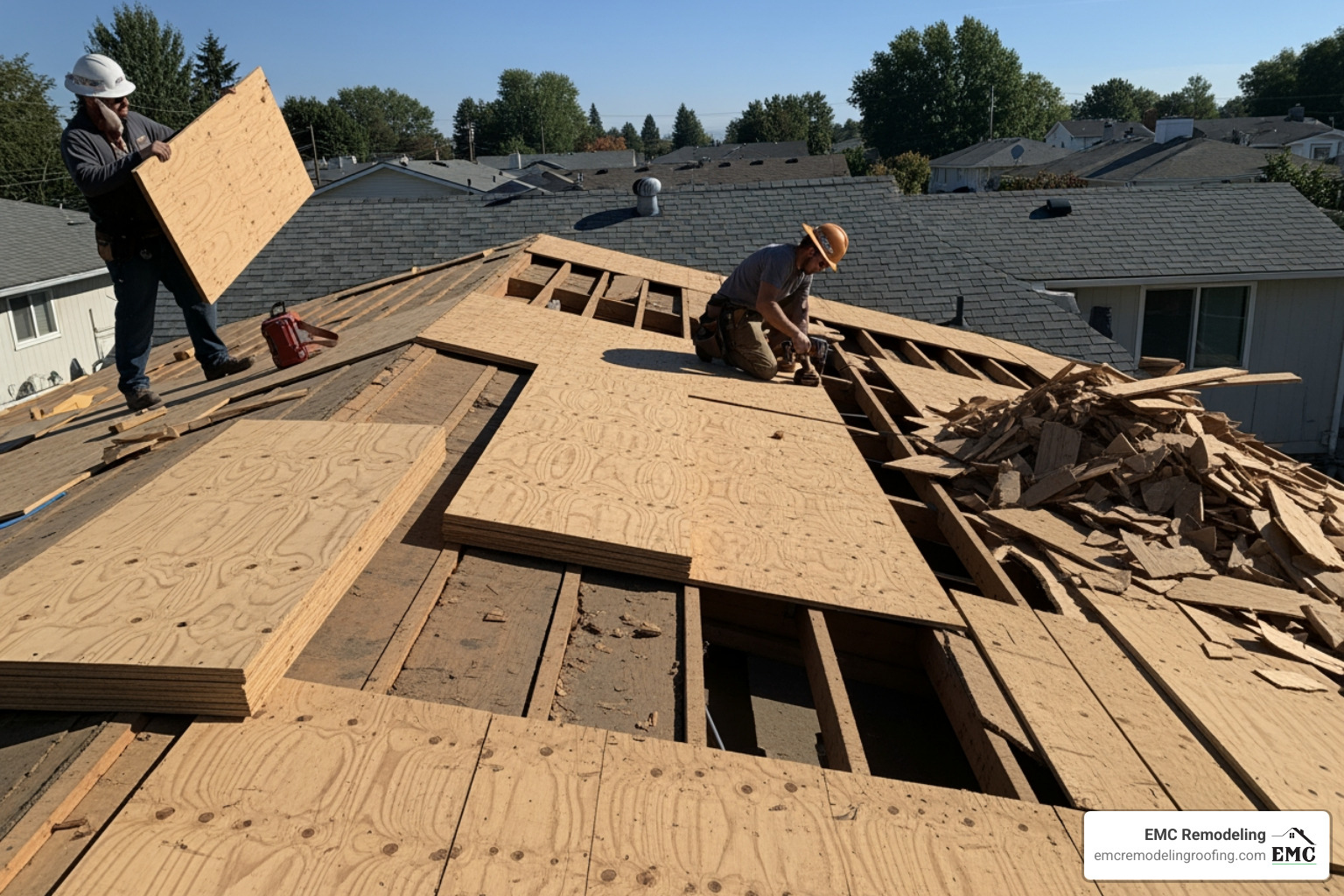
This is where the real work of a roof deck replacement begins. The goal is to expose the entire decking surface for a comprehensive evaluation and repair.
- Removing shingles: We carefully strip away all existing shingles, starting from the ridge and working our way down.
- Tearing off old underlayment: Once the shingles are gone, the underlying felt paper or synthetic underlayment is removed.
- Exposing the entire decking surface: With all layers removed, the condition of the roof decking becomes fully visible, allowing us to accurately identify all damaged areas.
- Proper disposal of old materials: All debris is carefully collected and disposed of according to local regulations, ensuring a clean and safe worksite.
Step 3: Removing Damaged Decking and Preparing the Structure
With the decking exposed, we can now address the compromised sections.
- Cutting out rotted sections: Using specialized tools, we precisely cut out all areas of rotted or damaged decking. We ensure that our cuts are made over existing rafters for proper support of the new decking.
- Inspecting roof trusses and rafters for collateral damage: Water damage often extends beyond the decking. We thoroughly inspect the underlying roof trusses and rafters for any signs of rot, mold, or structural weakness.
- Reinforcing structural members if needed: If we find compromised rafters or trusses, we reinforce or replace them to ensure the entire roof structure is sound and capable of supporting the new roofing system.
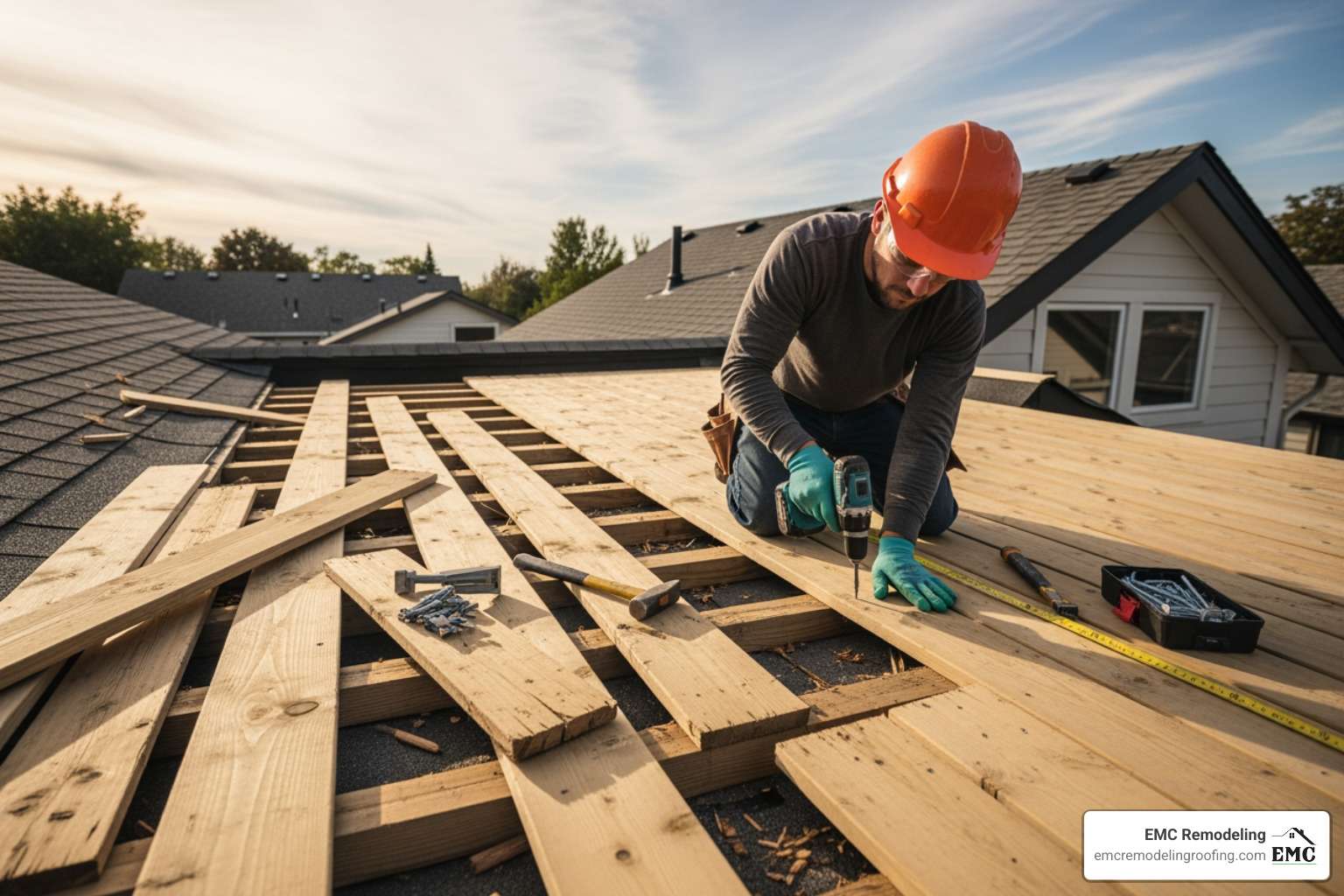
Step 4: Installing and Securing the New Decking
This step is about building a new, solid foundation for your roof.
- Matching new decking thickness to existing: It’s vital that the new decking matches the thickness of the existing, undamaged decking to ensure a smooth, uniform surface for the new roofing materials. As a reminder, most decking for asphalt shingle homes is 7/16-inch thick.
- Securing new sheets or planks: We carefully measure, cut, and install new plywood or OSB sheets (or planks, if applicable and compliant with current codes).
- Following NRCA fastener guidelines: We adhere strictly to the National Roofing Contractors Association (NRCA) guidelines for fastener placement: 6 inches on-center along supported edges and 12 inches on-center in the field. This ensures maximum uplift resistance and prevents movement, especially important in windy Central Texas.
Step 5: Reinstalling the Complete Roofing System
With the new decking securely in place, we proceed with rebuilding the protective layers of your roof.
- Installing new underlayment or ice and water shield: A fresh layer of high-quality underlayment is applied over the new decking. In critical areas like eaves and valleys, we install ice and water shield for improved protection against moisture intrusion.
- Proper flashing installation: All flashing around chimneys, vents, skylights, and in valleys is carefully installed or replaced to create watertight seals.
- Installing new shingles or other roofing material according to manufacturer specifications: Finally, the new roofing material (asphalt shingles, metal, etc.) is installed. We carefully follow manufacturer specifications to ensure proper installation, maximize the lifespan of your roof, and maintain warranty validity.
A complete roof replacement ensures all components work together seamlessly, providing your home with decades of reliable protection.
Costs, DIY Dangers, and Professional Services: Making Informed Decisions
Understanding the financial and safety implications of a roof deck replacement is crucial for making an informed decision for your home.
Breaking Down the Cost of a Roof Deck Replacement
The cost of a roof deck replacement is not a fixed number; it’s influenced by several factors:
- Material type: Plank decking costs about three times more per square foot than sheet decking. Within sheet decking, OSB is generally more affordable than plywood.
- Extent of damage: The more square footage of decking that needs replacement, the higher the material and labor costs.
- Labor rates: These vary based on the complexity of the job, the experience of the crew, and local market conditions in Central Texas.
- Additional repairs: If underlying rafters or trusses also need repair, this will add to the overall cost.
The cost for decking replacement is typically an additional line item on a new roof quote. It’s often determined after the old roofing materials have been torn off and the full extent of the damage can be seen.
Estimated Cost Comparison for Decking Materials (per square foot):
| Material Type | Typical Cost Range | Notes |
|---|---|---|
| OSB Sheet Decking | $1.50 – $3.00 | Most common, cost-effective, uniform. Often 7/16″ thick. |
| Plywood Sheet Decking | $2.50 – $4.50 | More traditional, slightly higher cost, good durability. |
| Plank Decking | $4.50 – $9.00 | Older style, typically 1×6 or 1×8 boards. About three times more expensive. |
Note: These are estimated ranges and actual costs can fluctuate significantly based on current lumber prices and local market conditions.
Investing in a sound roof is an investment in your home’s protection. Damage from weather and climate disasters over the last 43 years has exceeded over $2.6 trillion nationally, highlighting the critical importance of a sound roof as a preventative measure.
DIY vs. Hiring a Professional: A Safety-First Approach
We understand the temptation to save money by tackling home projects yourself. However, when it comes to a roof deck replacement, we strongly advise against a DIY approach. Roof repairs can be risky, and decking replacement is no exception.
- Fall hazards: Working on a roof is inherently dangerous. Falls are a leading cause of construction injuries, and even experienced professionals take extensive safety precautions.
- Risk of structural mistakes: Incorrectly cutting or installing decking can compromise the structural integrity of your entire roof, leading to costly future repairs or even collapse.
- Lack of proper tools: Professionals have specialized tools for safe tear-off, precise cutting, and secure fastening that most homeowners don’t own.
- Code compliance: Ensuring your replacement meets local building codes is complex. Mistakes can lead to failed inspections, fines, and forced re-work.
- Warranty invalidation: Many roofing material manufacturers will only honor warranties if their products are installed by certified professionals.
For these reasons, the expertise of an experienced roofing company is invaluable. We have the training, equipment, and insurance to perform the job safely and correctly.
Is Decking Included in a Standard Roof Replacement?
This is a common question, and the answer is typically a nuanced “yes, but it’s a contingency item.” When we provide an estimate for a full roof replacement, we always include a line item for potential decking replacement. This is because the full extent of damage is often unknown until the old roofing materials are torn off.
While we can sometimes identify signs of decking damage during an initial inspection, we can’t truly see everything until the shingles and underlayment are removed. Reputable contractors like us include clauses for potential decking replacement in their estimates, usually providing a per-sheet or per-board cost. This way, you’re prepared for the possibility, and there are no hidden surprises.
Always clarify this with your roofer upfront. A transparent estimate is a hallmark of a trustworthy company.
Frequently Asked Questions about Roof Deck Replacement
We get a lot of questions about roof decking, and we’re happy to clear things up. Here are some of the most common inquiries we receive from homeowners in Central Texas:
How can I prevent roof decking damage?
Prevention is key and involves regular maintenance. We recommend ensuring your attic has adequate ventilation to prevent heat and moisture buildup, especially in our humid Central Texas climate. Schedule annual professional roof inspections to catch small issues before they become big problems. Most importantly, address any leaks immediately, no matter how small, to prevent moisture from reaching the decking. A quick emergency roof repair can save you from costly structural issues down the line. Regular gutter cleaning also prevents water backup that can contribute to decking damage.
Can you install new decking over old, damaged decking?
It is never advisable to install new decking directly over rotted or structurally compromised wood. This practice traps moisture, accelerates decay, and fails to solve the underlying problem, ultimately leading to premature failure of your new roof. The only exception is when a roofer installs a new layer of code-compliant sheet decking (like OSB or plywood) over old, but stable, plank decking. This is done to create a solid, uniform surface necessary for modern asphalt shingles and to meet current building codes, especially if the gaps between the old planks exceed 1/8 inch. However, this is only acceptable if the original plank decking is otherwise sound and free from rot.
How long does roof decking last?
The lifespan of roof decking is directly tied to the health of the roofing system above it. If kept dry and well-ventilated, plywood or OSB decking can last for the entire life of the home, often 80 years or more. It’s designed to be a permanent structural component. However, once exposed to moisture due to leaks, poor ventilation, or storm damage, it can rot and fail rapidly, sometimes in just a few years. Proper installation, regular maintenance, and prompt leak repair are essential to maximize the lifespan of your roof decking.
Conclusion: Secure Your Home with a Solid Roof Foundation
Your roof decking is the unsung hero of your home’s structure. It’s the sturdy platform that supports your entire roofing system, protecting your family and your belongings from the relentless Central Texas weather. Ignoring signs of damage, whether it’s a subtle sag or a musty smell, can lead to catastrophic failure and expensive, extensive repairs that go beyond just the roof itself.
From identifying rot to understanding the meticulous replacement process, being informed empowers you to make the best decisions for your home and protect your investment. A professional roof deck replacement is a critical service that ensures your home’s long-term safety and structural integrity.
For homeowners in Central Texas, ensuring your roof is sound is paramount. We at EMC Remodeling pride ourselves on exceptional craftsmanship, direct owner involvement, and 24/7 emergency support. We offer expert assessments and quality craftsmanship for all your roofing needs, from minor repairs to complete replacements. If you suspect an issue with your roof decking or are facing an urgent problem, don’t wait. Contact us 24/7 at (254) 265-6163 or schedule a professional roof repair service today. We’re your trusted local partner, ready to secure your home with a solid roof foundation.
