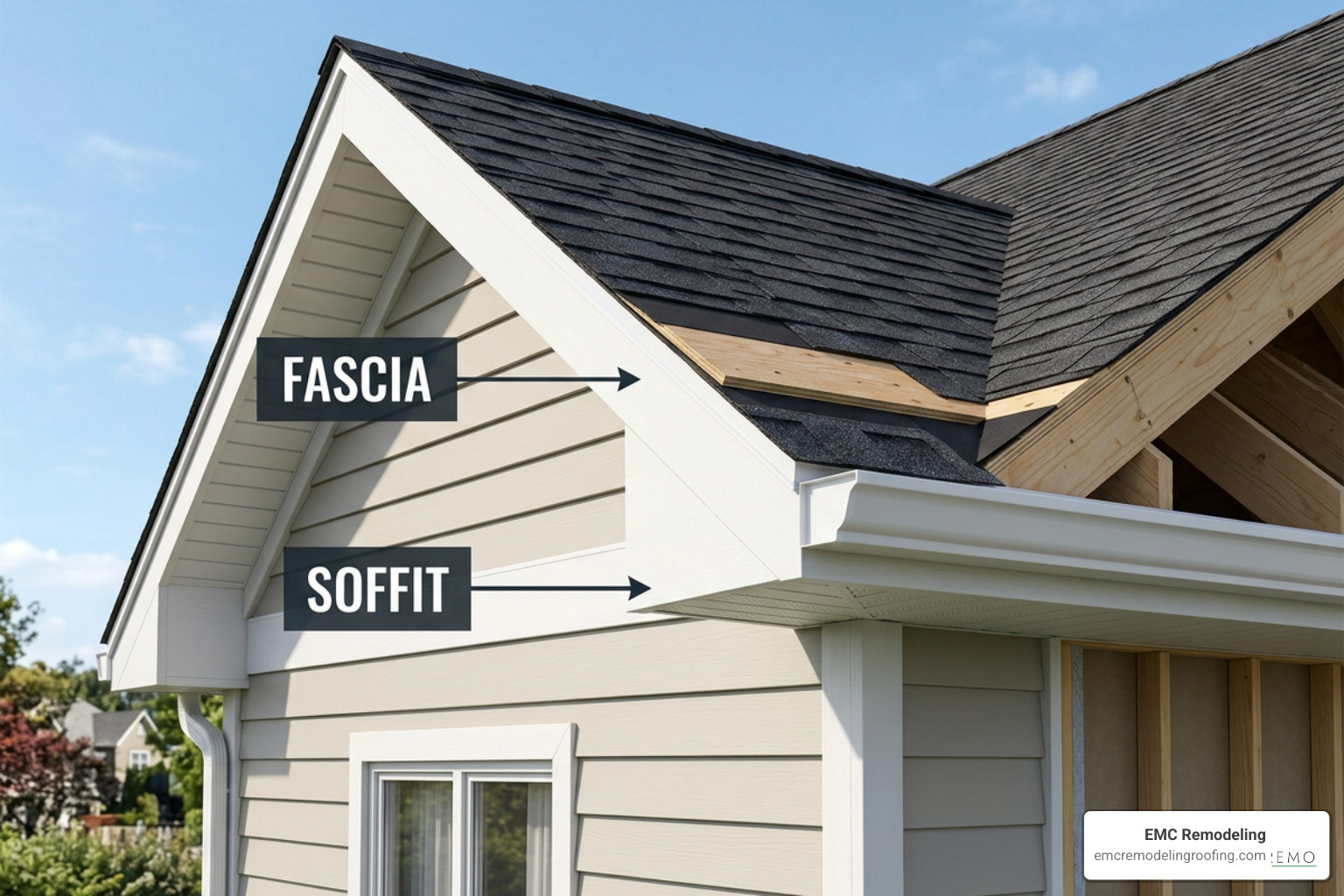
What Are Fascia and Soffit? A Quick Guide to Your Home’s Roof Trim
Your home’s fascia and soffit are two of the hardest-working components on your entire exterior — and most homeowners couldn’t point to either one.
Here’s the short answer, optimized for a quick scan:
| Component | Location | Primary Job |
|---|---|---|
| Fascia | Vertical board along the roof’s lower edge | Supports gutters, seals the roofline |
| Soffit | Horizontal panel under the roof overhang | Ventilates the attic, blocks pests |
| Drip Edge | Metal flashing above the fascia | Directs water away from the fascia |
Together, they form the trim system at your roof’s edge — protecting your rafters, regulating attic airflow, and giving your home a finished look from the street.
When either one fails, the consequences move fast. Water gets behind the gutters. Pests find a gap. Attic moisture builds up. What starts as peeling paint can quietly become rotting rafters. That’s why knowing these components — and catching problems early — matters for any Central Texas homeowner.
As a trusted exterior home repair resource, EMC Remodeling sees this play out on Central Texas homes every season, from Temple to the surrounding Hill Country.
I’m Matthew Runyon, President of EMC Remodeling & Roofing, and over my 15+ years in the roofing and remodeling industry, fascia and soffit repairs have been among the most consistent — and most overlooked — issues I’ve seen on Central Texas homes. In this guide, I’ll walk you through everything you need to identify, evaluate, and protect your roof trim.
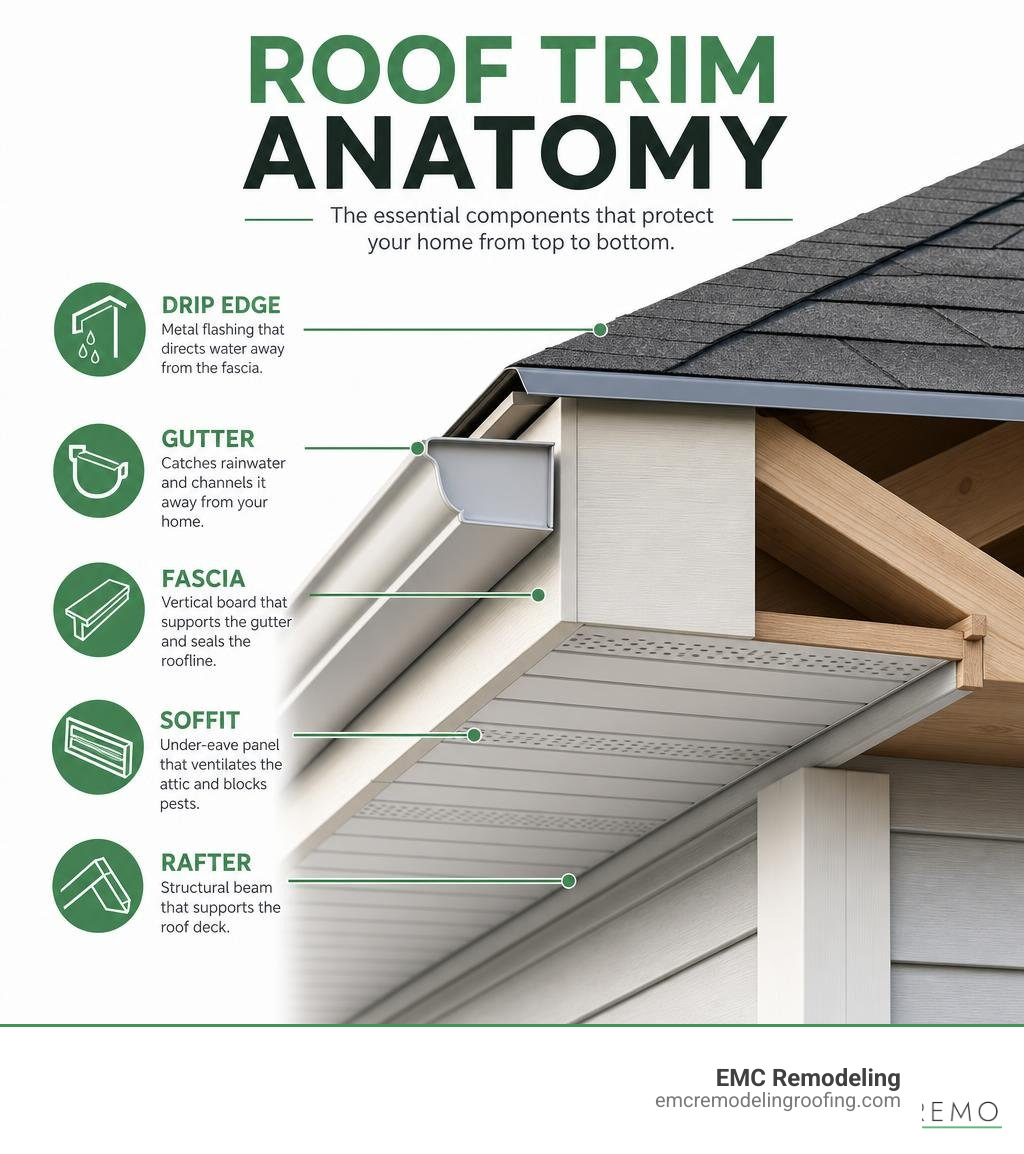
Fascia and soffit terms made easy:
What Is Roof Trim? Identifying Your Home’s Eaves Components
Roof trim refers to the protective boards and architectural elements that seal your home’s roofline where the shingles meet the exterior walls. This area, collectively known as the eaves, features a roof overhang designed to shed rainwater away from the foundation. Without these trim components, your rafter tails — the structural wooden beams supporting your roof deck — would remain completely exposed to rain, wind, baking heat, and nesting pests.
Understanding the anatomy of your eaves is the first step toward successful exterior home repair. When a storm rolls through Central Texas, your roof trim acts as a unified barrier. The fascia boards close off the vertical face of the roofline, while the soffit panels seal the triangular gap underneath the overhang.
Together, these components provide critical structural backing for your gutter system, protect your home’s framing, and establish a pathways for attic ventilation. For a deep dive into how these structures fit into your home’s overall design, you can consult this comprehensive What Is Soffit and Fascia on a House? Homeowner’s Guide.
The Vertical Shield: Understanding the Role of Fascia
The fascia is the long, straight vertical board running directly along the lower edge of your roof. It is fastened securely to the ends of your wooden roof trusses or rafter tails.
Fascia plays several indispensable roles in protecting your home:
- Gutter Mounting Surface: Fascia serves as the primary structural foundation for your gutter system. When a heavy Central Texas downpour occurs, your gutters can channel several gallons of water per second. The fascia board must bear this immense physical weight without flexing, warping, or pulling away from the rafters.
- Water Barrier: It caps the end of the roofline, preventing wind-driven rain from blowing backward underneath your shingles and soaking the wooden roof deck.
- Shingle Support: Fascia supports the bottom row of your shingles or tiles, ensuring they do not sag or crack under their own weight at the edge of the roof.
The Horizontal Vent: Understanding the Role of Soffit
The soffit is the horizontal panel installed on the underside of your roof’s overhang, closing the gap between the exterior siding and the outer edge of the fascia board. The word “soffit” originates from the Latin term subfixus, which literally translates to “fixed underneath.”
Soffit serves two primary functions:
- Attic Air Intake: Most modern soffit panels feature small perforations or built-in vents. These openings act as the intake point for your home’s attic ventilation system, drawing in fresh, cool air from the lowest point of the roofline.
- Pest Barrier: By completely sealing the underside of the eaves, the soffit prevents birds, squirrels, wasps, and rodents from exploiting gaps in your rafters to build nests in your attic.
Drip Edge vs. Fascia: Clearing Up the Confusion
Many homeowners confuse the drip edge with the fascia board because both sit at the very edge of the roofline. However, they are entirely different components made of different materials, though they work closely together to prevent water damage.
A drip edge is an L-shaped metal flashing piece installed directly on top of the roof deck, beneath the underlayment, and overlapping the top edge of the fascia board. Its primary job is water shedding. The drip edge forces rainwater to cascade off the shingles and drop cleanly into the center of the gutters, rather than clinging to the shingles and running down the face of the wooden fascia board.
Without a functioning drip edge, water will seep behind your gutters, leading to rapid rot and structural failure of the fascia. To learn more about how to diagnose and address these issues, check out our Roof Eaves Repair Complete Guide.
Material Options for Your Roofline: Cost, Durability, and Maintenance
Choosing the right material for your fascia and soffit is a balancing act between upfront installation costs, long-term durability, and the amount of maintenance you are willing to perform. Over 80% of new soffit and fascia installations in the United States utilize aluminum or vinyl due to their low-maintenance profiles and long service lifespans.
Here is how the four primary materials compare:
| Material | Durability | Maintenance Interval | Average Lifespan | Best Suited For |
|---|---|---|---|---|
| Vinyl | High (No rot or rust) | Annual wash only | 20–30 Years | Budget-friendly, low-maintenance projects |
| Aluminum | High (Corrosion resistant) | Clean every 2–3 years | 30–40 Years | High-wind areas, modern aesthetics |
| Wood | Moderate (Prone to rot) | Paint/seal every 2–4 years | 15–25 Years | Historical homes, custom wood designs |
| Fiber Cement | Extremely High (Fire/rot proof) | Paint every 10–15 years | 40–50 Years | Extreme climates, maximum fire resistance |
Comparing the Costs of Fascia and Soffit Materials
The upfront cost of replacing your roof trim depends heavily on the material you select. When budgeting, keep in mind that fascia is typically priced by the linear foot, while soffit is often calculated by either the linear foot or square foot depending on the depth of your roof overhang.
- Vinyl: The most budget-friendly option. Homeowners can expect to pay $5 to $15 per linear foot installed for vinyl soffit and fascia.
- Aluminum: A durable, mid-range choice. Aluminum soffit and fascia typically cost $8 to $12 per square foot installed.
- Wood: Traditional and beautiful, but labor-intensive. Wood soffit and fascia cost $10 to $15 per square foot installed, and often require professional carpentry for the best results.
- Fiber Cement: A premium, ultra-durable option. Fiber cement soffit and fascia run between $12 and $15 per square foot installed.
If you are planning to upgrade your roofline, combining this work with a broader exterior project can save on overall labor costs. Read more about how these systems integrate on our Siding and Gutters page.
How Climate Affects Your Material Selection
The extreme climate of Central Texas plays a major role in how your fascia and soffit materials age over time. In cities like Temple and Leander, TX, your roofline must withstand intense summer heat, high humidity, sudden severe thunderstorms, and occasional freezing winter temperatures.
- Texas Heat and UV Exposure: Intense sunlight can cause cheap vinyl to become brittle and warp over time if it is not installed with adequate room for expansion and contraction. Wood trim boards will dry out, crack, and require frequent repainting to prevent UV damage.
- Humidity and Rot Resistance: High humidity levels accelerate wood rot and fungal decay. If you choose wood, it must be factory-primed, treated with protective preservatives like zinc borate, and sealed thoroughly on all sides. Aluminum and fiber cement are highly resilient in humid climates because they do not absorb moisture or rot.
How Proper Fascia and Soffit Ventilation Protects Your Attic
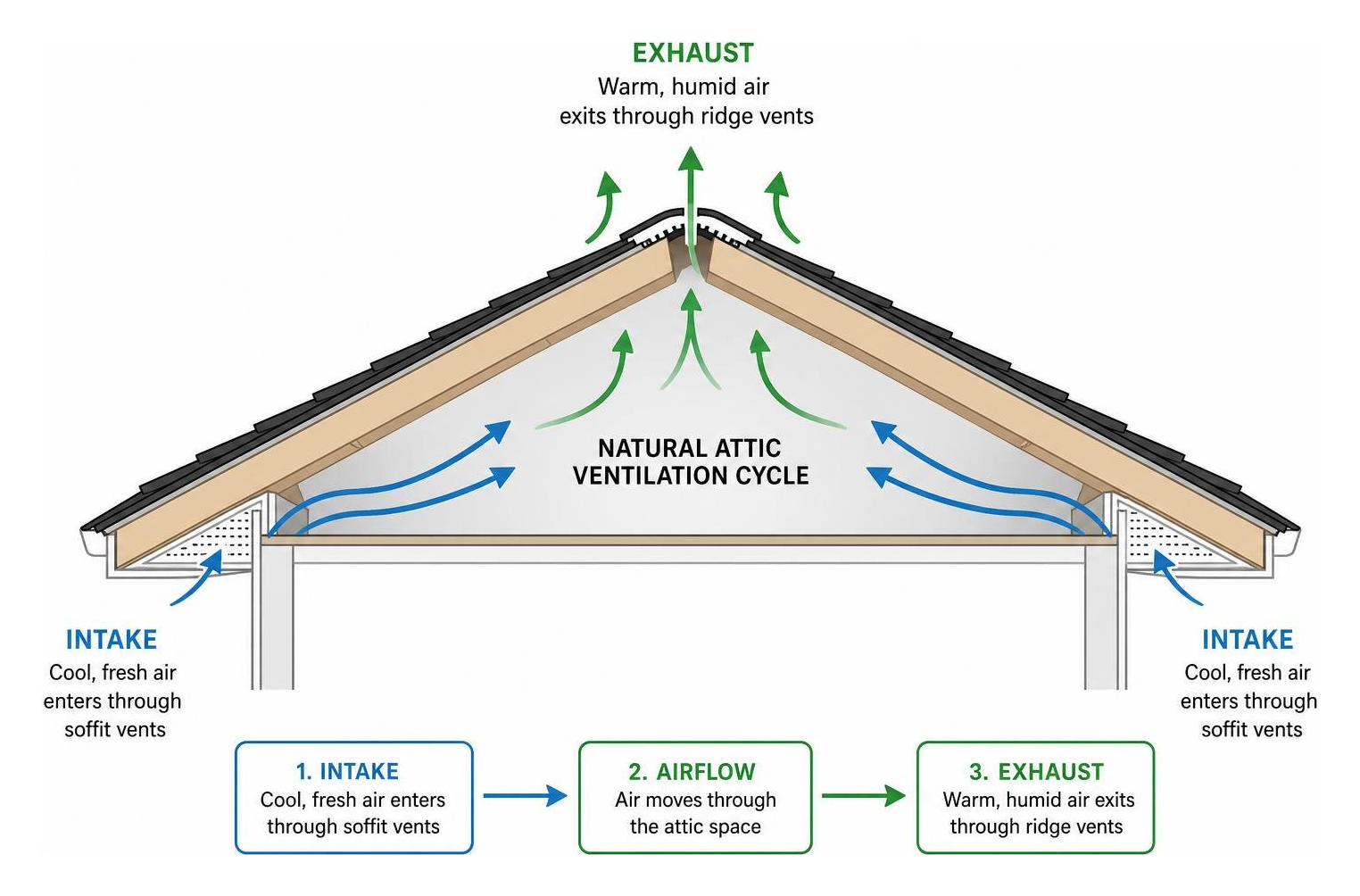
Proper attic ventilation is not just about keeping your home comfortable; it is a critical factor in extending the lifespan of your entire roof system. Your attic space requires a continuous, balanced cycle of natural airflow.
Fresh, cool air must enter at the lowest point of the roof (intake) and warm, humid air must exit at the highest point (exhaust). To explore the mechanics of this process in detail, read about The Best Roof Ventilation Solutions for Your Home.
Net Free Air (NFA) Requirements and Attic Health
Most modern building codes require a specific ratio of ventilation to attic space to prevent heat and moisture buildup. The standard code requires at least 1 square foot of net free ventilation area (NFA) per 150 to 300 square feet of attic floor area.
To achieve a balanced system, this ventilation must be split evenly: 50% intake ventilation located under the eaves (via vented soffits) and 50% exhaust ventilation located at the ridge peak. While standard vinyl or fiber cement soffits provide an average of 5 to 7 NFA, high-performance engineered systems can deliver up to 10 NFA, ensuring your attic stays dry and your roof manufacturer’s warranty remains fully compliant.
Preventing Ice Dams and Reducing Energy Costs
Properly ventilated soffits deliver major financial and structural benefits:
- Extending Roof Lifespan: By preventing heat from trapping against the underside of your roof deck, proper soffit ventilation can extend your roof’s overall life by 10% to 15%.
- Lowering Energy Bills: In hot summer months, a well-ventilated attic can run up to 30 degrees cooler, significantly reducing the load on your HVAC system and lowering your monthly cooling costs.
- Preventing Ice Dams: During rare Central Texas winter freezes, trapped attic heat can melt snow on the upper sections of your roof. As that melted water runs down to the cold eave line, it refreezes, creating ice dams that pry shingles loose and cause severe water leaks. Constant airflow through vented soffits keeps the roof deck at a uniform temperature, preventing this cycle entirely.
Warning Signs Your Roof Trim Needs Repair or Replacement
Because your fascia and soffit are tucked away high up on your home’s exterior, damage often goes unnoticed until it has spread to the underlying roof framing. Conducting a visual inspection from the safety of your yard twice a year — ideally during your spring and fall gutter cleanings — can save you thousands of dollars in emergency repairs.
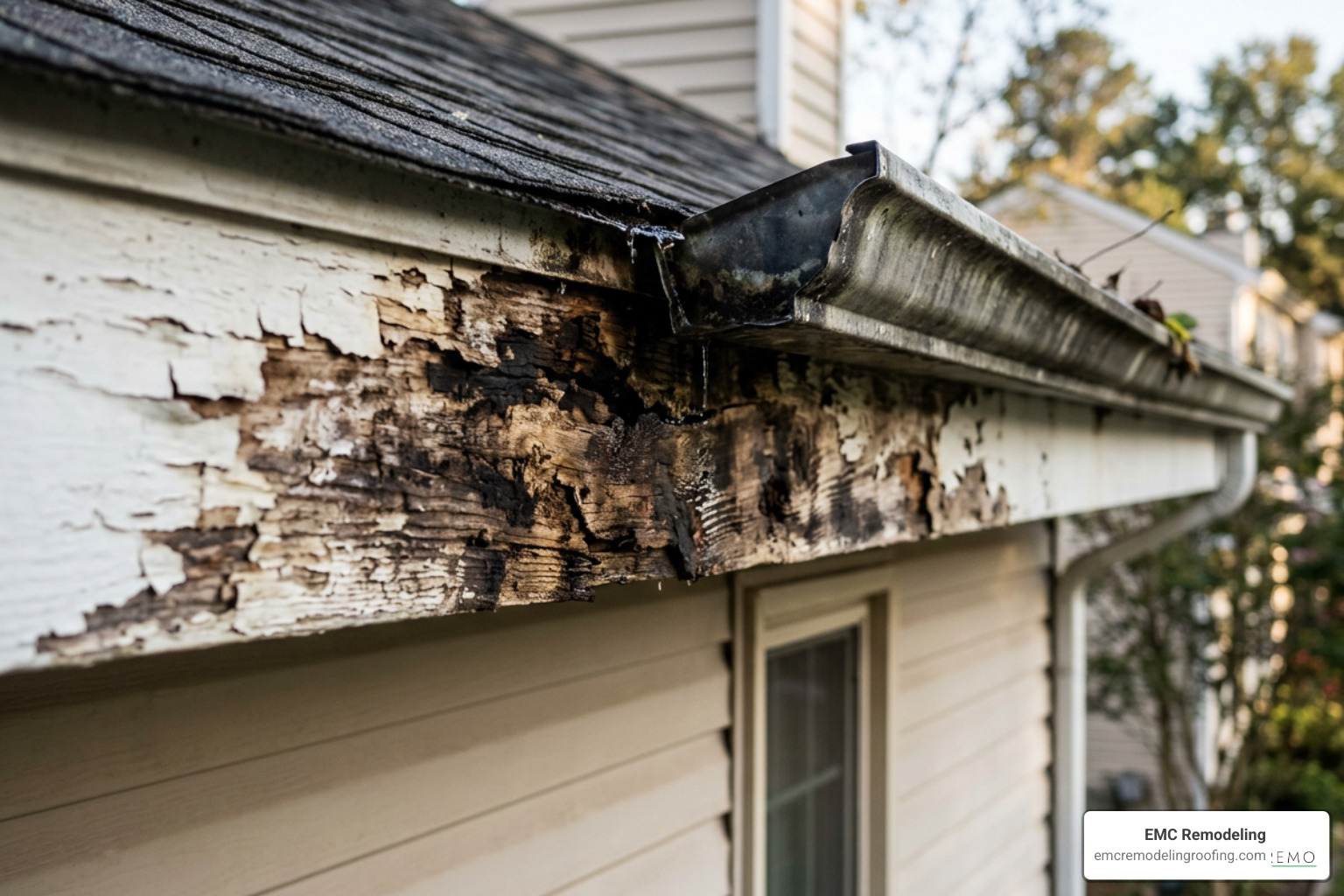
Identifying Rot, Pest Damage, and Sagging Gutters
When inspecting your roofline, look out for these common warning signs:
- Peeling, Cracking, or Flaking Paint: This is the first indicator that moisture has breached your paint barrier and is beginning to saturate the wood beneath.
- Spongy or Crumbling Wood: If you can gently press a screwdriver into your wood fascia or soffit and it feels soft, spongy, or crumbles, structural rot has set in.
- Sagging Gutters: If your gutters are pulling away from the house, the nails or screws may be losing their grip because the fascia board behind them has rotted and softened. If you notice your gutters pulling loose, consult our Gutter Repair Near Me Guide immediately.
- Water Stains and Mold: Dark streaks on your siding or musty odors in your attic point to trapped moisture and failing roof trim.
- Pest Activity: Small holes, claw marks, or birds constantly nesting in your eaves indicate that your soffits have physical gaps that pests are exploiting.
When to Spot-Repair vs. Fully Replace Your Fascia and Soffit
Deciding whether to patch a small section of damaged trim or replace the entire run depends on the extent of the damage:
- The 20% Rule: If less than 20% of a continuous run of fascia or soffit is damaged, and the surrounding wood is completely solid and structurally sound, a localized spot-repair is a highly cost-effective solution.
- When Full Replacement is Needed: If the damage is widespread, or if the structural integrity of the rafter tails behind the fascia has been compromised, a full replacement is required. Replacing the entire run ensures a cohesive visual finish and prevents hidden rot from spreading.
- Gutter Integration: Because your gutters are directly mounted to the fascia, replacing fascia boards almost always requires removing and reinstalling your gutter system. If your gutters are already old, combining fascia replacement with a new gutter installation is highly recommended. For more details on making this decision, see Soffit vs. Fascia: What to Know, When to Replace.
Frequently Asked Questions About Roof Trim
How much does professional roof trim installation cost?
On average, professional soffit replacement costs between $20 and $30 per linear foot installed, while fascia replacement runs between $15 and $25 per linear foot installed. These rates vary based on the height of your home, the material selected, and whether your existing gutters must be removed and reinstalled. For a complete breakdown of project costs, read our Roof Eaves Repair Cost Guide.
Can I replace my roof trim as a DIY project?
While handy homeowners can tackle minor spot repairs, a complete fascia and soffit replacement is best left to professional roofing contractors. Working at heights on tall ladders or scaffolding carries significant safety risks. Furthermore, because your roof trim integrates directly with your shingles, drip edge, and gutter systems, improper DIY installation can easily lead to hidden water leaks that rot your rafters and void your roof’s warranty.
How long do modern roof trim systems last?
With proper installation and minimal maintenance, modern vinyl and aluminum fascia and soffit systems have an expected lifespan of 20 to 30 years. Premium materials like fiber cement can easily last 40 to 50 years. To maximize this lifespan, ensure your gutters are cleaned regularly to prevent water from overflowing onto your fascia boards, and inspect your roofline annually for any signs of physical damage.
Conclusion
Your home’s fascia and soffit are critical structural components that keep your attic dry, your home energy-efficient, and your roofline safe from water damage and pests. Keeping these elements in top shape is one of the smartest investments you can make in your property’s long-term health.
At EMC Remodeling, we are proud to be a family-operated business serving our neighbors in Temple, TX, Leander, TX, and the surrounding Central Texas communities. We bring direct owner involvement, exceptional craftsmanship, and 24/7 emergency support to every project we touch.
Whether you need a quick spot repair after a severe storm or a complete roofline upgrade, our team is here to help. Explore our professional roof repair services to schedule your free, photo-documented estimate today!
