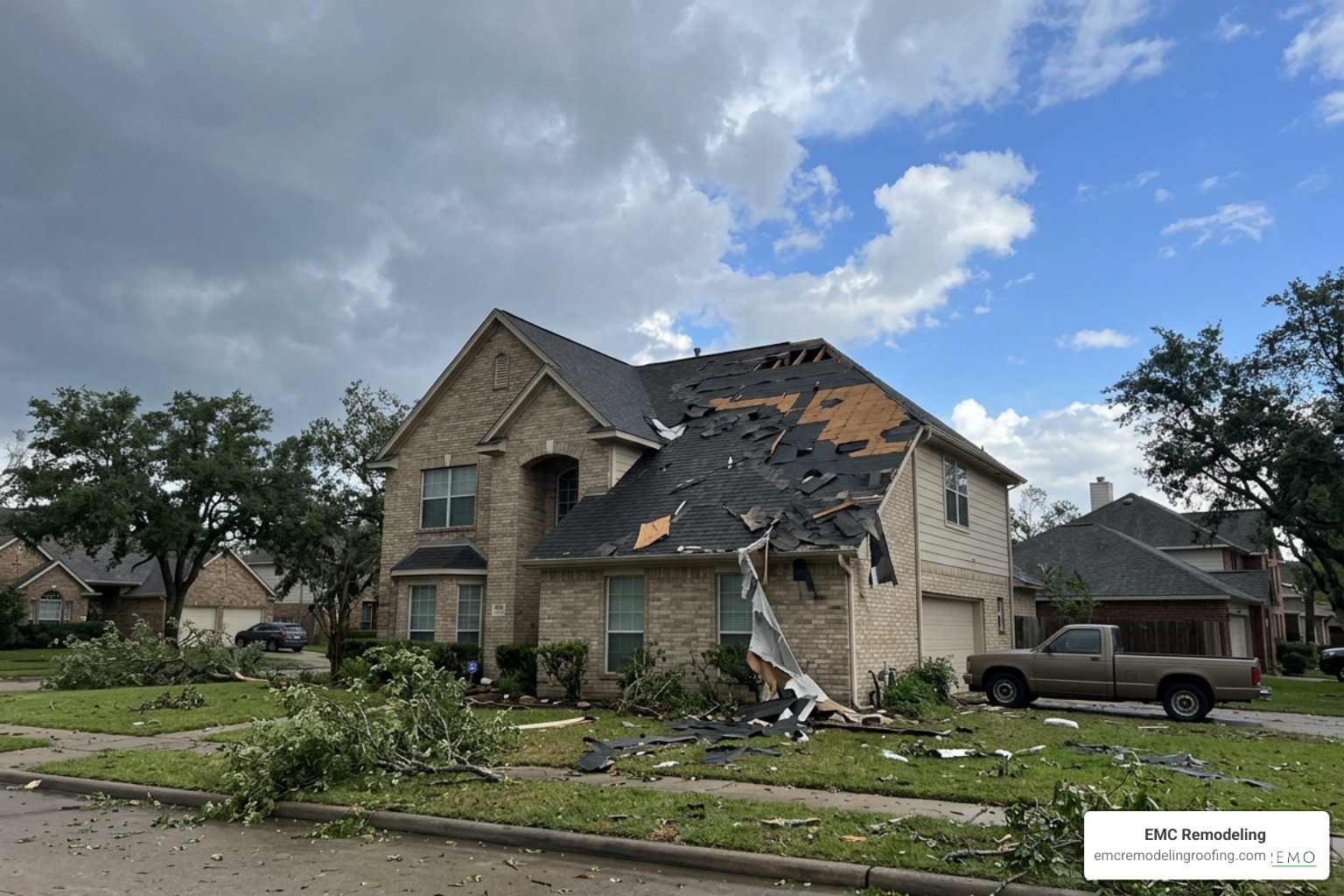
When Storms Strike: What Every Central Texas Homeowner Needs to Know
A storm damage roof repair service is a professional solution that inspects, documents, and restores roofs after severe weather — protecting your home from leaks, mold, and structural failure.
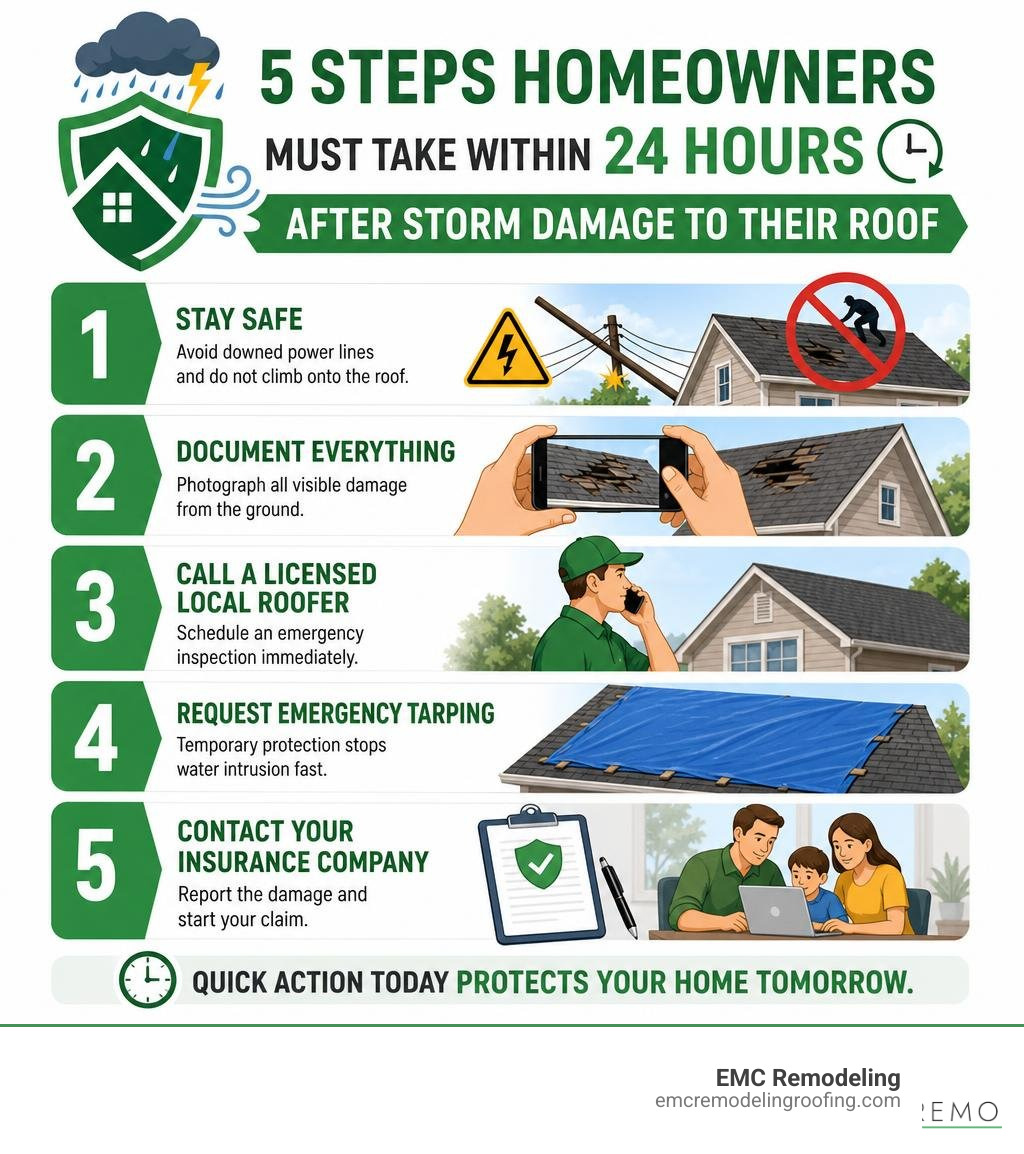
What to do in the first 24 hours after storm damage:
- Stay safe — avoid downed power lines and do not climb onto the roof
- Document everything — photograph all visible damage from the ground
- Call a licensed local roofer — schedule an emergency inspection immediately
- Request emergency tarping — temporary protection stops water intrusion fast
- Contact your insurance company — report the damage and start your claim
When severe weather hits Central Texas, finding a reliable storm damage roof repair service quickly is the single most important step you can take to protect your home’s structural integrity. Hail and wind storms cause an estimated $25–30 billion in insured property damage every year across the United States — and roofing accounts for the largest share of those claims. Delays of even a few days can turn a straightforward shingle repair into a full roof replacement, with mold, rot, and interior water damage compounding the cost.
The hard truth is that storm damage is not always visible from the ground. Small hailstones can fracture the fiberglass mat inside an asphalt shingle without leaving an obvious dent. Wind can break the sealant strip beneath a shingle tab, leaving your roof deck exposed to the next rain. Homes with roofs older than 15 years are three times more likely to sustain severe damage during a hail or wind event — yet many homeowners don’t realize there’s a problem until water stains appear on their ceiling weeks later.
That’s why professional assessment matters. Our storm damage repair process is designed to catch both visible and hidden damage before it escalates.
I’m Matthew Runyon, President of EMC Remodeling & Roofing — a family-owned company based in Temple, Texas, with over 15 years of hands-on experience delivering storm damage roof repair service to Central Texas homeowners. If you need immediate assistance, you can Call EMC Remodeling at (254) 300-1234. I’ve personally overseen hundreds of post-storm restorations across the region, and I’ll walk you through exactly what to look for, how to choose the right contractor, and how to navigate the insurance process with confidence.
Explore more about storm damage roof repair service:
Identifying the Signs of Severe Weather Roof Damage

Identifying storm damage early is the key to preventing extensive, secondary structural issues. While a tree branch lying across your ridge line is an obvious emergency, the most destructive storm damage is often the quietest. Over time, overlooked compromises in your roof’s outer barrier allow moisture to seep into your decking, insulation, and drywall.
In Central Texas, where intense sun follows severe spring and summer storms, trapped moisture creates a perfect incubator for mold and wood rot. To protect your home, you must know how to evaluate your property’s exterior. Homeowners should regularly refer to our comprehensive Residential Roof Storm Damage Guide to understand how to spot these subtle signs of compromise before they escalate into major financial headaches.
Recognizing Hail Damage on Asphalt Shingles
Hail damage is notoriously deceptive. Many homeowners look up at their roof after a hailstorm and assume everything is fine because they do not see missing shingles. However, hail damage is rarely about missing materials; it is about compromised structural integrity.
When a hailstone strikes an asphalt shingle, it creates a localized compression area. This impact forces the protective mineral granules to shed, exposing the dark asphalt substrate underneath. More importantly, the physical shock often fractures the underlying fiberglass mat of the shingle. This micro-fracture instantly voids manufacturer warranties and creates a direct pathway for water to migrate through the shingle over subsequent months.
Without professional hail damage roof repair, these bruised spots degrade rapidly under the harsh Texas sun, leading to latent leaks that may not show up inside your living room until winter.
Spotting Wind and Debris Damage
High winds present a different set of challenges for residential roofing systems. Standard asphalt shingles are rated to withstand specific wind velocities, but wind patterns during severe thunderstorms or microbursts can lift and twist shingles in unexpected ways.
When wind speeds exceed a shingle’s design limits, the wind can get underneath the shingle tabs, creating “uplift.” This physical force breaks the manufacturer’s thermal sealant strip. Once this bond is broken, the shingle may settle back down, appearing perfectly normal from the ground. However, because the seal is gone, the shingle will flap and lift during the next moderate breeze, allowing driving rain to slide directly underneath the shingle and onto your underlayment.
In more severe cases, wind will crease the shingle tabs, tear them completely off, or throw heavy storm debris onto the roof, causing structural punctures. Because these compromised seals are practically invisible from the front yard, our storm damage specialists utilize advanced physical diagnostics and close-up inspections to locate every single unsealed shingle on your roof.
Choosing a Professional Storm Damage Roof Repair Service
Following a major severe weather event in Central Texas, local neighborhoods are often flooded with out-of-state “storm chasers.” These are transient roofing crews who travel from state to state following storm maps. They use high-pressure sales tactics, demand large upfront deposits, and often promise to “waive” your insurance deductible (which is highly illegal in the state of Texas). Once they complete a rapid, often sub-standard installation, they disappear, leaving you with no recourse when the roof begins to leak a year later.
Choosing an established, licensed, and insured local roofing contractor is the only way to guarantee that your roof is restored in strict compliance with local building codes. To safeguard your investment, read our guide on choosing a top storm damage roof replacement contractor before signing any agreements.
Why DIY Roof Repairs Can Void Your Insurance
It can be incredibly tempting to grab a ladder, a bucket of plastic roof cement, and some home improvement store shingles to patch a leak yourself. However, attempting DIY roof repairs after a storm is one of the quickest ways to ruin your chances of a successful insurance claim.
Insurance adjusters require a clear, unaltered “forensic” picture of the storm damage to approve a claim. When a homeowner applies DIY patches, smears roof cement over bruised shingles, or replaces damaged sections themselves, they alter the evidence. Adjusters may claim that the damage was caused or worsened by improper DIY installation, giving them a valid reason to deny the claim. Furthermore, manufacturers will not honor material warranties on shingles that were not installed by certified professionals using specific fastener patterns.
Rather than risking your safety and your policy coverage, you will find immense long-term financial benefits in weathering the storm with professional repair services that keep your warranties and insurance claims completely intact.
Finding a Reputable Storm Damage Roof Repair Service Near You
A reputable local contractor will have a permanent physical office, verifiable local references, and deep roots in the community. They will understand the unique regional weather patterns of Central Texas and will be fully registered with local municipal building departments in areas like Temple, Belton, and Leander.
When evaluating a storm damage roof repair service, always ask for their physical address and verify their credentials. Look for companies that carry robust general liability insurance and workers’ compensation. If you are in the Leander area, you can cross-reference local providers by checking trusted resources like THE BEST 10 ROOFING NEAR LEANDER, TX 78641 – Yelp. Working with a verified local professional ensures that your project complies with Texas building standards and that your workmanship warranty will actually be honored years down the road.
The Step-by-Step Storm Damage Restoration Process
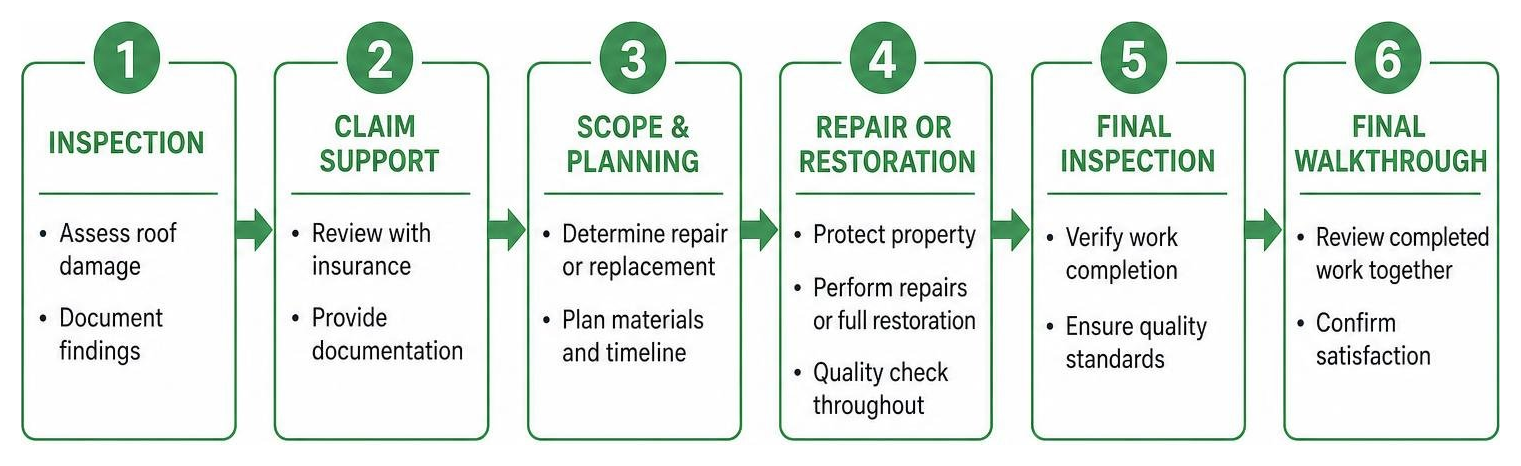
Restoring a storm-damaged roof is a structured, highly technical process. It is not just about nailing down new shingles; it is about evaluating the entire roofing system — from the wooden deck and ventilation systems to the flashing and underlayment.
To help you understand your options, here is a comparison of how we handle minor repairs versus a comprehensive roof restoration:
| Restoration Feature | Minor Roof Repair | Full Roof Restoration |
|---|---|---|
| Primary Scope | Replacing isolated missing shingles, sealing minor flashing leaks | Complete tear-off of old materials down to the bare wood deck |
| Deck Inspection | Limited to the immediate repair area | Comprehensive evaluation of all plywood/OSB decking sheets |
| Underlayment | Patching existing underlayment | 100% replacement with premium synthetic underlayment |
| Ice & Water Shield | Rarely applied | Installed in all critical leak-prone areas (valleys, penetrations) |
| Average Timeline | 2 to 4 hours | 1 to 2 days (physical construction phase) |
| Warranty Coverage | Limited to the repaired patch | Comprehensive lifetime material and multi-year workmanship warranties |
Understanding the distinct phases of this process helps you make informed decisions. For a deeper, highly technical look at the workflow, read our Residential Storm Damage Restoration Complete Guide.
Emergency Mitigation and Roof Tarping
The moment a storm compromises your roof, a countdown clock begins. Homeowners are contractually obligated under standard Texas HO-3 insurance policies to take immediate action to mitigate further damage to their property. If you allow rain to continue pouring into an open roof wound because you waited weeks for an insurance adjuster to visit, your insurance carrier can legally deny coverage for the subsequent interior water damage.
That is why emergency mitigation is our first priority. Our rapid-response emergency roof repair services are available 24/7 to stabilize your home. We deploy heavy-duty, UV-resistant polyethylene tarps secured with wooden batten strips and ring-shank nails to create a temporary, watertight seal. This stops water intrusion instantly, giving you the breathing room needed to document the damage and process your insurance claim without worrying about your ceilings collapsing.
Comprehensive Inspection and Advanced Damage Mapping
Once your home is temporarily protected, we perform a forensic roof inspection. We do not just glance at the roof from the ground. We get up on the shingles to perform a hands-on physical evaluation.
Our inspection methodology includes:
- Physical Decking Evaluation: Walking every square foot of the roof to locate soft spots that indicate water-saturated decking.
- Advanced Damage Mapping: Marking out a “test square” (a 10ft x 10ft area) on each slope of your roof to document the exact number of hail impacts and wind-damaged shingles.
- Detail Inspections: Closely examining critical transition zones, including chimney flashing, valley linings, plumbing vent boots, and attic ventilation systems.
- Drone-Assisted Imaging: Capturing high-resolution aerial photography to provide undeniable, time-stamped proof of the damage for your insurance carrier.
Navigating the Insurance Claims Process with Your Contractor
Filing a storm damage insurance claim can feel like trying to learn a foreign language overnight. Insurance policies are packed with complex terminology like “Actual Cash Value (ACV),” “Replacement Cost Value (RCV),” “depreciation,” and “deductibles.”
Having an experienced local roofing contractor by your side is invaluable during this process. We act as your technical guide, ensuring that your insurance company receives an accurate, code-compliant, and comprehensive scope of work. While we specialize in residential properties, we bring the same level of rigorous documentation and professional representation that is standard in commercial storm damage restoration to every single home we serve.
Documenting Damage for a Storm Damage Roof Repair Service
The success of your insurance claim depends entirely on the quality of your documentation. Insurance companies process thousands of claims after a major storm, and their primary goal is to minimize their financial exposure. If your documentation is vague, your claim may be delayed, underpaid, or denied entirely.
We compile an adjuster-ready digital report for your insurance carrier. This includes time-stamped, high-resolution photographs of every damaged facet, close-ups showing the exact diameter of hail impacts, and wide-angle shots showing the context of the storm’s path. We also provide an itemized, line-by-line estimate using Xactimate — the exact same estimating software used by major insurance adjusters. By presenting your insurance company with a professional, standardized scope of damage through our hail repair roofing documentation services, we eliminate the guesswork and streamline your claim’s approval.
Understanding Supplements and Deductibles
It is incredibly common for an insurance adjuster’s initial estimate to be lower than the actual cost of a proper repair. In fact, insurance carriers report that 25–30% of storm damage claims are initially underpaid. This is not necessarily due to bad faith; adjusters simply cannot see hidden damage — such as rotted plywood decking or compromised flashing — until the old shingles are completely torn off.
When we uncover this hidden damage during the construction phase, we submit a “supplement” to your insurance company. A supplement is a formal request supported by photographic evidence and local building code documentation, asking the insurer to cover the additional, necessary costs to complete the repair correctly. We handle this entire supplemental process on your behalf, ensuring that your roof is restored to modern safety standards. For more insights on how we manage comprehensive exterior restorations, explore our expert tips on siding and exterior storm damage repair.
Frequently Asked Questions About Storm Damage Roof Repair
How long does storm damage roof repair typically take?
Most residential storm damage roof repairs take 1 to 2 days to physically complete, though the entire process — including insurance approvals, material procurement, and scheduling — can take 2 to 6 weeks. Once our crews arrive on-site with materials, we work quickly to complete the tear-off, decking repairs, and new shingle installation so that your home is exposed to the elements for the shortest time possible.
Will my homeowners insurance cover the entire cost of roof restoration?
Homeowners insurance typically covers the full cost of roof restoration minus your deductible, provided the damage was caused by a sudden, covered peril like wind or hail, and not by pre-existing wear and tear. If you have a Replacement Cost Value (RCV) policy, your insurer will pay to restore the roof to its pre-storm condition. If you have an Actual Cash Value (ACV) policy, they will deduct depreciation based on the age of your roof, meaning you will have to pay more out of pocket.
What size hail causes functional damage to asphalt shingles?
Hail measuring 1 inch in diameter (quarter-sized) or larger is scientifically proven to cause functional damage to standard asphalt shingles, including bruising, granule loss, and latent leaks. At 1.5 inches (golf ball-sized), shingle cracking and immediate water intrusion pathways become common, and hail over 2 inches almost always warrants a complete, immediate roof replacement to prevent catastrophic structural failure.
Conclusion
Your roof is your home’s first and most important line of defense against the unpredictable Central Texas weather. When severe storms strike Temple, Belton, or Leander, you cannot afford to wait and see if a small leak becomes a major flood. Partnering with a trusted, local, and experienced storm damage roof repair service is the best way to protect your family, your property, and your peace of mind.
At EMC Remodeling & Roofing, we are proud to be Temple’s trusted, family-operated roofing experts. We bring exceptional craftsmanship, direct owner involvement, and rapid 24/7 emergency support directly to your doorstep when you need it most. We live and work in the very communities we serve, and we treat every roof we restore as if it were protecting our own family.
Don’t let hidden storm damage compromise your home’s safety. Schedule a professional roof repair with us today to protect your property and restore your peace of mind.
