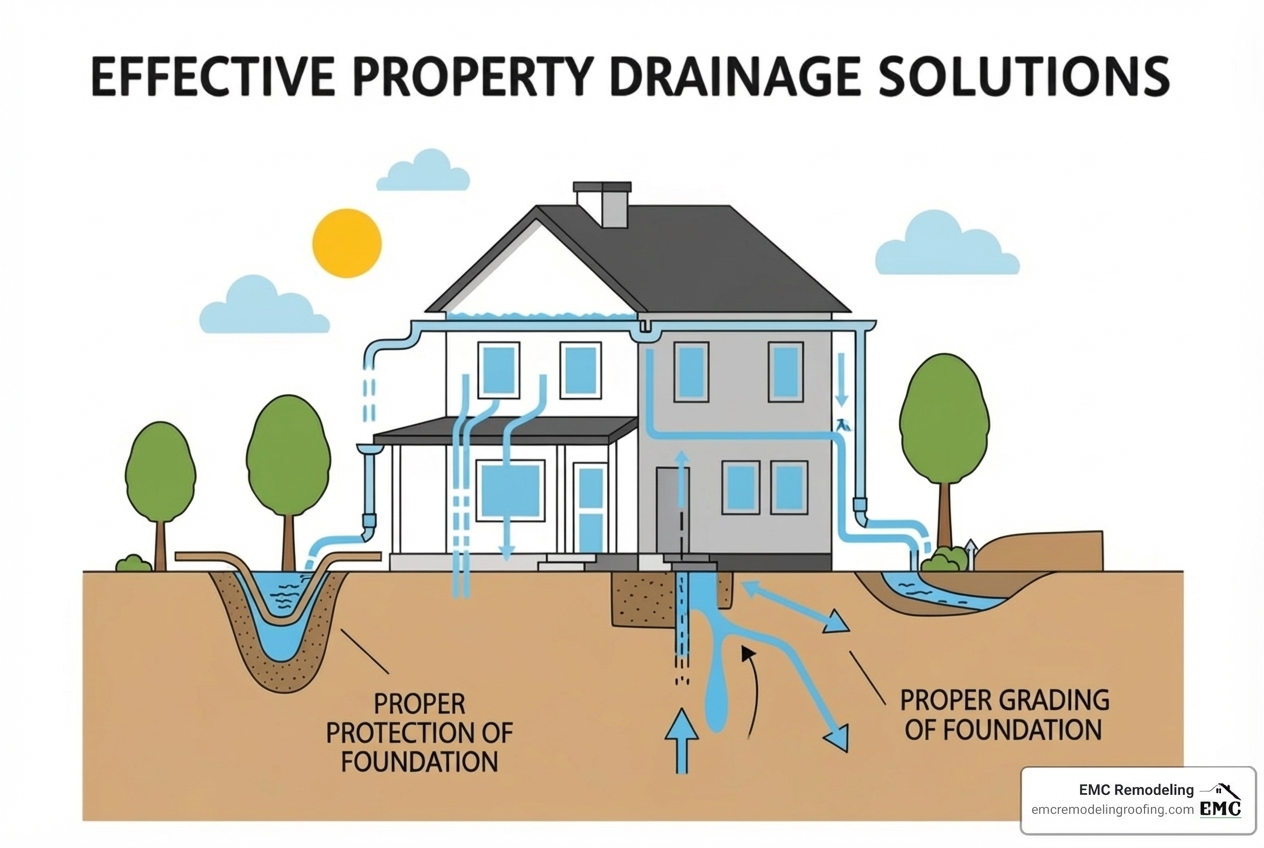
Why Effective Property Drainage Solutions Matter for Your Home
Property drainage solutions are essential systems that protect your home by managing water flow away from your foundation, preventing costly damage and maintaining structural integrity. Whether you’re dealing with standing water, a soggy lawn, or basement leaks, the right drainage strategy can save you thousands in repairs while preserving your property’s value.
Quick Answer: The Most Effective Property Drainage Solutions
- Roof & Gutter Systems – Clean gutters, properly placed downspouts, and extensions (first line of defense)
- French Drains – Underground perforated pipes that redirect subsurface water away from problem areas
- Grading & Sloping – Land contoured to direct water away from the foundation (minimum 1-inch-per-foot slope)
- Catch Basins & Dry Wells – Collect and disperse excess water underground
- Channel Drains – Surface trenches that capture water from driveways, patios, and walkways
- Rain Gardens & Permeable Paving – Eco-friendly solutions that allow water to absorb naturally
The problem starts where you might not expect it—your roof. When rainwater hits your roof, it needs a clear path away from your home. Without proper gutters, downspouts, and yard drainage, that water pools around your foundation, creating hydrostatic pressure that can crack concrete, flood basements, and compromise your home’s structural integrity.
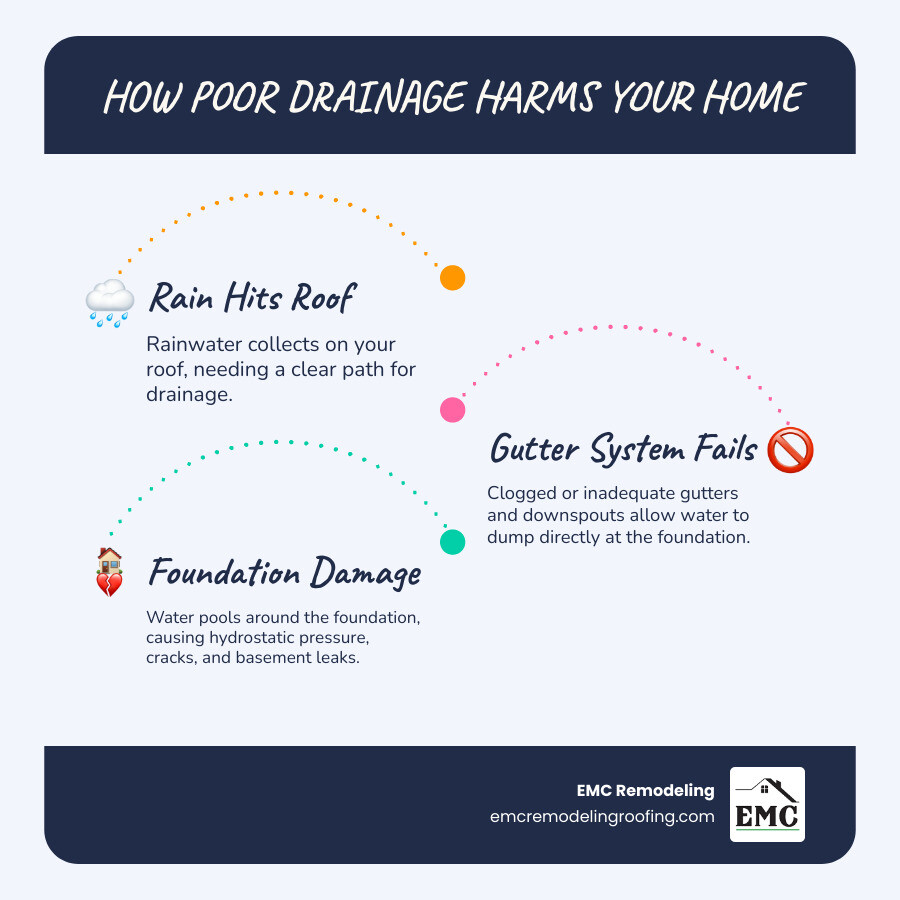
The diagram above illustrates how water travels from your roof, through gutters and downspouts, and should be directed away from your foundation through proper grading and drainage systems. When any part of this system fails, water accumulates at your foundation, leading to expensive damage.
The real cost of poor drainage extends beyond puddles in your yard. Research shows that foundation repairs can cost homeowners between $2,000 and $10,000 or more, while a properly installed drainage system typically ranges from $1,800 to $5,000—a fraction of the repair bill. Even worse, water damage can decrease your property value by 10-15% according to real estate professionals.
Central Texas homeowners face unique challenges. Our clay-heavy soil expands when saturated, putting additional pressure on foundations. Combined with intense storms and occasional flooding, effective property drainage solutions aren’t optional—they’re critical protection for your investment.
I’m Matthew Runyon, President of EMC Remodeling & Roofing, and over my 15 years in the industry, I’ve seen how proper property drainage solutions can prevent thousands of dollars in water damage while protecting the homes of families throughout Temple and Central Texas. Our team specializes in comprehensive exterior solutions, from roof installations to complete drainage systems that work together to keep your property dry and secure.
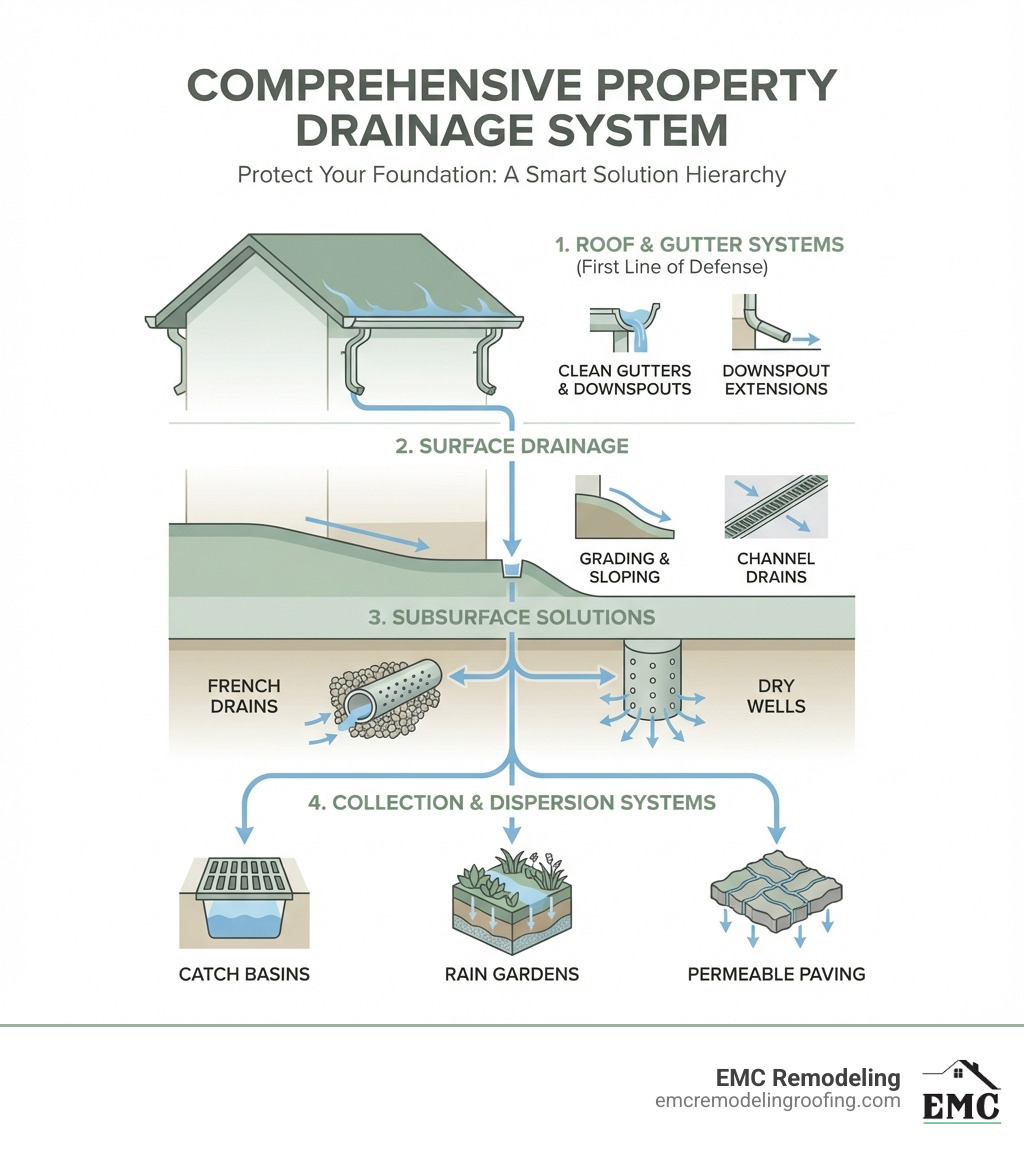
This infographic shows the complete property drainage solution hierarchy, starting with roof and gutter systems at the top (your first line of defense), followed by surface drainage (grading, channel drains), subsurface solutions (French drains, dry wells), and finally collection/dispersion systems (catch basins, rain gardens, permeable paving).
Basic property drainage solutions terms:
The Silent Threat: Recognizing and Understanding Poor Drainage
Poor property drainage often goes unnoticed until the damage is already significant. Recognizing the early warning signs can save you from extensive and costly repairs. We understand the unique challenges Central Texas homeowners face, where heavy rains can quickly overwhelm inadequate systems.
What are the common signs of poor property drainage?
The most common signs of poor drainage include:
- Pooling water: Puddles forming in your yard, on patios, or near your foundation long after it has rained.
- Soggy lawn: Areas of your lawn that remain squishy or muddy, hindering plant growth and making outdoor spaces unusable.
- Basement leaks: Water seeping into your basement or crawl space, often visible as damp spots, stains, or even standing water.
- Musty odors: A damp, earthy smell in your basement or crawl space, indicating mold or mildew growth due to excessive moisture.
- Soil erosion: Visible channels or washouts in your landscaping, where moving water has carried away soil.
- Cracks in foundation: Hairline or larger cracks appearing in your home’s foundation, which can be a direct result of hydrostatic pressure from saturated soil.
- Pest infestations: Waterlogged areas are breeding grounds for mosquitoes and other pests, making your yard less enjoyable.
What are the risks associated with inadequate property drainage?
The risks of ignoring these signs are severe and can impact your home’s safety, value, and your family’s health:
- Structural foundation damage: Saturated soil exerts immense pressure against your foundation walls, leading to cracks, shifting, and structural instability. This is particularly relevant in Central Texas with our expansive clay soils.
- Mold and mildew growth: Persistent dampness in basements and crawl spaces creates an ideal environment for mold and mildew, which can trigger allergies, respiratory issues, and other health problems.
- Pest infestations: Standing water attracts mosquitoes, termites, and other insects that can damage your home and carry diseases.
- Decreased property value: Drainage issues are a major red flag for potential buyers and can significantly reduce your home’s market value.
- Costly repairs: Addressing foundation issues, water damage, or mold remediation can quickly become a significant financial burden, often far exceeding the cost of proactive drainage solutions.

When dealing with water-related emergencies, especially those impacting your roof and leading to potential drainage problems, timely action is crucial. Learn more about our emergency roof repair services to address urgent issues promptly.
Your First Line of Defense: Roof and Gutter Drainage Systems
Before water ever touches your landscape, its journey begins on your roof. This makes your roof and gutter system the absolute first line of defense against property drainage issues. Ensuring these systems are in top condition is paramount for protecting your home in Cedar Park, Leander, Georgetown, and across Central Texas.
What are storm drains and their importance?
While municipal storm drains are large systems collecting runoff from streets, your home’s gutters and downspouts act as your personal storm drain system. They are designed to collect rainwater from your roof and channel it safely away from your home’s foundation. Their importance cannot be overstated:
- Preventing foundation damage: By diverting thousands of gallons of water away from your foundation annually, they prevent the hydrostatic pressure that leads to cracks and leaks.
- Protecting siding and landscaping: They prevent water from cascading down your walls, which can damage siding, erode landscaping, and create muddy conditions around your home.
- Avoiding basement flooding: Properly functioning gutters and downspouts are crucial in preventing water from accumulating around the perimeter of your home, where it can seep into basements and crawl spaces.
Gutter Function and Downspout Importance
Gutters catch rainwater as it flows off your roof. Downspouts are the vertical pipes that carry this collected water down to the ground level and, ideally, away from your foundation. Seamless gutters, which we specialize in, minimize leaks and offer superior performance compared to sectional gutters. Explore options for residential seamless gutters that provide a sleek, efficient solution.
Gutter Maintenance
Regular maintenance is key. We recommend cleaning gutters at least twice a year, especially in areas with many trees, to prevent debris buildup. Clogged gutters can overflow, rendering them useless and directing water precisely where you don’t want it – next to your foundation.
Downspout Extensions
Even the best gutters need help directing water far enough away. Downspout extensions are simple, often inexpensive additions that ensure water is discharged several feet away from your home’s perimeter. A general rule of thumb is to extend them at least 4 feet away.
Rain Barrels
For an eco-friendly approach, rain barrels can be incorporated into your downspout system. These collect rainwater, which can then be used for watering lawns and gardens, reducing reliance on municipal water and managing runoff. Just remember to direct any overflow away from your foundation, at least six feet, and disconnect them in the fall to prevent freezing and damage.
Roof Flashing
Beyond gutters, another critical roofing component for water management is flashing. Roof flashing is a vital component of your roofing system, preventing water from penetrating your home where different roof planes meet or where the roof intersects with other elements like chimneys, skylights, and vents. Flashing channels water away from these vulnerable areas. Without properly installed and maintained flashing, water can seep into your home, causing significant damage over time. Regular inspections of your roof, including flashing, are crucial to catch issues before they escalate.
We offer expert gutter installation services custom to the specific needs of homeowners in Temple, Killeen, Belton, and surrounding areas. Our seamless gutters are designed for maximum efficiency and durability.
Comprehensive Property Drainage Solutions for Your Landscape
Once water leaves your roof and gutters, your landscape takes over. Effective property drainage solutions for your yard are crucial for managing surface runoff and subsurface water. Landscaping plays a significant role in this, as thoughtful design can direct water where it needs to go, or allow it to be absorbed, preventing it from pooling around your home. We approach landscape drainage with a holistic view, considering both visible and hidden strategies. For an overview of effective strategies, refer to Site Drainage Practices to Minimize Localized Flooding.
Surface and Sub-Surface Property Drainage Solutions
Managing water on and under your property requires a combination of techniques.
How does grading and sloping the land contribute to effective drainage?
Grading and sloping the land is often the most fundamental and effective property drainage solution. It involves reshaping your yard to create a gentle incline that directs water away from your foundation.
- The 1-inch-per-foot rule: A minimum gradient of one inch per foot for at least six to ten feet away from your foundation is recommended. This ensures gravity effectively pulls water away from your home.
- Benefits: Proper grading prevents pooling, reduces soil erosion, and protects your foundation from hydrostatic pressure. It’s often the first step we recommend in a comprehensive drainage plan.
What is a French drain and how does it work?
A French drain is a sub-surface drainage system designed to redirect groundwater and surface water away from problem areas.
- How it works: A trench is dug, lined with water-permeable landscape fabric, and filled with a layer of aggregate (gravel). A perforated pipe is then laid on top of the gravel, with its holes facing downwards, and covered with more aggregate and the remaining fabric. This system collects water through the aggregate and perforations, channeling it via gravity to a designated discharge point, such as a storm drain, dry well, or a sloped area away from your property.
- Benefits: French drains are discreet once installed, as they can be covered with soil or grass, making them an excellent choice for managing soggy lawns or preventing water from reaching your foundation. They are particularly effective in areas with clay soil, common in Central Texas, where water struggles to percolate naturally. For installation guidance, you can refer to How do I install a French drain?.
What are channel drains and where are they typically used?
Channel drains are surface drainage systems typically used in hardscaped areas.
- How they work: These are long, narrow trenches covered with grates, designed to quickly capture surface water before it can pool or flow into undesirable areas.
- Typical uses: You’ll commonly see them in driveways, patios, pool decks, and walkways to prevent water from running into garages, basements, or adjacent landscaped areas. They are highly effective for managing large volumes of runoff from impervious surfaces.
Beyond these landscape solutions, don’t forget the importance of well-maintained gutters. Read our gutter sealing guide for 2025 to ensure your roof’s drainage is sealed tight.
Collection and Dispersion Property Drainage Solutions
Sometimes, simply redirecting water isn’t enough; you need to collect and manage it on-site.
How do catch basins and dry wells help manage water runoff?
Catch basins and dry wells are excellent property drainage solutions for collecting and gradually dispersing water.
- Catch basins: These are underground boxes with grates at the surface, placed at low points in your yard or hardscapes. They capture large volumes of surface runoff, preventing pooling and debris from entering the drainage pipes. The collected water is then channeled through an underground pipe system to a suitable discharge point.
- Dry wells (soakaway pits): A dry well, also known as a soakaway pit, is an underground pit filled with gravel or rock, often lined with geotextile fabric. Water from downspouts, catch basins, or French drains is directed into the dry well, where it slowly percolates into the surrounding soil. This reduces the burden on municipal storm drains and is an effective solution for managing runoff on your property. For details on installation, consult resources like Property Drainage Solutions. You can also find out the cost of a dry well to help with your budgeting.
How can rain barrels and rain gardens be incorporated into a drainage strategy?
Rain barrels and rain gardens are eco-friendly and aesthetic ways to manage water.
- Rain barrels: As mentioned earlier, rain barrels collect water from downspouts for later use. This reduces the amount of runoff entering your yard and storm drains.
- Rain gardens: These are shallow depressions planted with native, water-tolerant plants. They are designed to collect and absorb rainwater runoff from impervious surfaces like roofs and driveways. The plants and specialized soil mixture help filter pollutants and allow water to slowly soak into the ground, replenishing groundwater. They are a beautiful and functional addition to any landscape, especially in areas prone to pooling.
What are the benefits of permeable paving surfaces for drainage?
Permeable paving surfaces are innovative property drainage solutions that allow water to pass directly through them, reducing runoff and promoting groundwater recharge.
- How they work: Unlike traditional concrete or asphalt, permeable pavers, porous concrete, or permeable asphalt have void spaces that allow rainwater to infiltrate the ground below.
- Benefits: These surfaces reduce stormwater runoff, minimize the need for complex drainage systems, help filter pollutants, and can even reduce the urban heat island effect. They are an excellent choice for driveways, patios, and walkways where traditional paving would otherwise create significant runoff.
Choosing Your System: When to DIY vs. Call a Professional
Deciding on the right property drainage solution for your home in Killeen, Pflugerville, or anywhere in Central Texas can be complex. While some minor issues might be DIY-friendly, others require professional expertise.
When is it necessary to consult a professional for drainage issues?
It’s often necessary to consult a professional for drainage issues when:
- Foundation problems are evident: If you notice cracks in your foundation, water in your basement, or signs of structural shifting, these are serious issues that require immediate professional assessment.
- Complex drainage systems are needed: Installing French drains, dry wells, or extensive grading requires specialized knowledge of hydrology, soil mechanics, and proper installation techniques. Incorrect installation can worsen the problem or even damage your home.
- Significant water volume: If your property experiences heavy runoff or persistent flooding, a professional can design a system to handle the volume effectively.
- Uncertainty about the cause: A professional can accurately diagnose the root cause of your drainage issues, which may not always be obvious.
- Permit requirements: Some drainage installations may require permits, and professionals are familiar with local regulations.
What are the key considerations when choosing a drainage system for a specific property?
When selecting a property drainage solution, we consider several factors:
- Soil type: Central Texas often has expansive clay soils, which drain poorly. This influences the choice between surface and subsurface solutions.
- Property slope and topography: The natural lay of your land dictates how water flows and which solutions (e.g., grading, swales, French drains) will be most effective.
- Rainfall volume and intensity: Our region can experience intense storms, requiring robust systems capable of handling significant water volumes.
- Budget considerations: Costs vary widely, from simple downspout extensions to complex French drain systems. We work with you to find solutions that fit your budget while addressing the problem effectively.
- Aesthetics: Some solutions, like rain gardens or permeable pavers, can improve your landscape, while others, like hidden French drains, are designed to be invisible.
- Regulatory requirements: Always check for local building codes and permit requirements before starting any significant drainage project. For any digging, remember to contact utility locating services (like 811 in the US) to mark underground lines.
While some basic tasks like cleaning gutters or adding downspout extensions can be DIY, complex issues like regrading your yard or installing sub-surface drains are best left to professionals. Incorrectly installed systems can lead to more severe problems down the line. For example, if you’re experiencing ongoing gutter issues in Salado or need a more robust system, it’s time to get help with your gutters in Temple, TX or nearby service areas.
Are there any regulatory or permit requirements for installing drainage systems?
Yes, depending on the scope and location of your drainage project, there can be regulatory or permit requirements. These vary by municipality and state. For instance, any work that impacts public stormwater systems, alters natural water flow across property lines, or involves significant excavation might require a permit. Always check with your local planning or building department in your specific Central Texas city (Temple, Lago Vista, Killeen, etc.) before undertaking major drainage work. Additionally, before any digging, it’s crucial to contact 811 to have underground utility lines marked, preventing accidental damage and ensuring safety.
Frequently Asked Questions about Property Drainage
How much does a yard drainage system cost?
The cost of a yard drainage system varies significantly based on the type of solution, the size of your property, the complexity of the installation, and whether you choose a DIY approach or professional installation. Simple DIY fixes like downspout extensions might only cost tens of dollars. However, professional systems can range from a few hundred to several thousand dollars. For example, installing a French drain can cost anywhere from $10 to $100 per linear foot, while a dry well installation might range from $1,500 to $5,000. These are general estimates, and actual costs can vary. For more detailed estimates, you can refer to resources like Angi’s drainage cost estimates.
How do I fix a soggy, waterlogged yard?
Fixing a soggy, waterlogged yard typically involves a multi-step approach:
- Check and clean gutters and downspouts: Ensure they are free of debris and properly directing water away from your home.
- Add downspout extensions: Extend downspouts at least 4-6 feet away from your foundation.
- Aerate your lawn: For compacted soil, aeration creates channels for water to penetrate deeper.
- Improve grading: Reshape your landscape to ensure a minimum 1-inch-per-foot slope away from your home.
- Install a French drain: If surface solutions aren’t enough, a French drain can effectively channel subsurface water away from problem areas.
- Consider a dry well or rain garden: These can help collect and slowly disperse excess water into the ground.
Can poor drainage really damage my home’s foundation?
Yes, absolutely. Poor drainage is one of the leading causes of foundation damage. Here’s how:
- Hydrostatic pressure: When soil around your foundation becomes saturated with water, it expands and exerts immense hydrostatic pressure against your basement walls and slab. This pressure can cause the foundation to crack, bow inward, or even shift.
- Foundation cracks: These cracks allow water to seep into your basement or crawl space, leading to leaks, mold, and further structural damage.
- Structural shifting: Over time, continuous cycles of soil expansion (when wet) and contraction (when dry) can lead to uneven settling of your foundation, causing structural shifting throughout your home, including cracks in walls, sticking doors, and uneven floors.
- Costly repairs: Foundation repairs are among the most expensive home repairs, often costing thousands of dollars and requiring specialized contractors. Proactive property drainage solutions are a far more economical and effective preventative measure.
Conclusion: Safeguard Your Investment with the Right Drainage Strategy
Effective property drainage solutions are not merely an aesthetic choice; they are a critical investment in the longevity, safety, and value of your Central Texas home. From the roof to the landscape, every component plays a vital role in preventing water damage that can lead to costly foundation repairs, mold growth, and decreased property value.
We believe that proactive management is the smartest strategy. Starting with a robust roof and gutter system, and extending to thoughtfully designed landscape drainage, you can create a comprehensive defense against the elements. Our expertise at EMC Remodeling, serving communities like Temple, Lago Vista, Cedar Park, and Georgetown, ensures that your home is protected with custom solutions that stand up to our unique climate.
Don’t wait for the signs of water damage to become undeniable. Safeguard your investment and ensure your home remains a dry, healthy, and valuable asset for years to come. Contact us for a professional gutter installation assessment or to discuss your comprehensive property drainage needs today.